

Select Page
Bateleur eagle: Habitats, Diet, Fun facts and More
The Bateleur Eagle Introduction
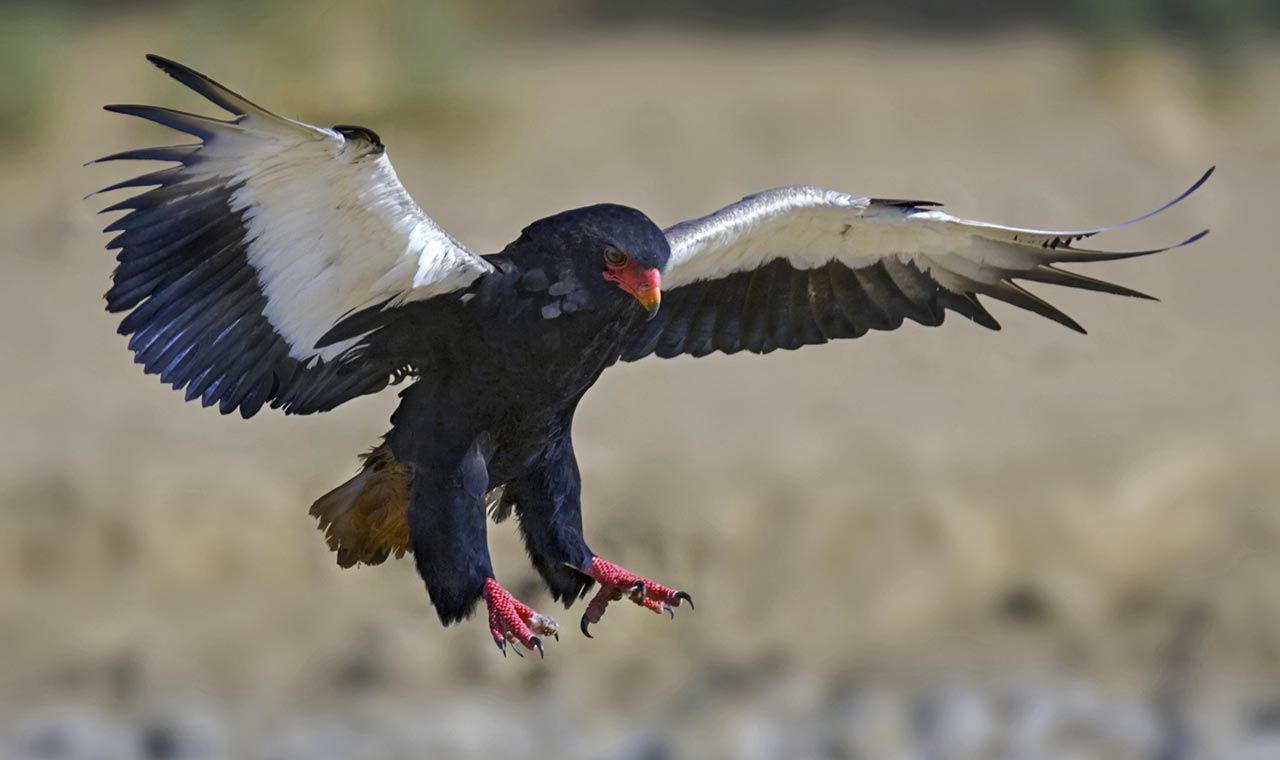
Your first clear sight of a Bateleur Eagle can feel almost too dramatic to be real. The Bateleur Eagle flies low over the savanna with bold black wings, a bright red face and legs, and a short tail that makes the whole body look compact and sharp at the same time. For a second you stop breathing and follow that shape with your eyes, even if lions are sleeping near the road.
If you come from a busy American or European city, you probably imagine eagles as mountain or forest birds. The Bateleur Eagle shows you something different. It glides over open country, rocking slightly from side to side, scanning for movement with a head that hardly seems to move. Every tilt of its wings feels deliberate. You sit in the vehicle, hearing only the engine and the wind, and feel that this bird has been patrolling these skies far longer than your maps have existed.
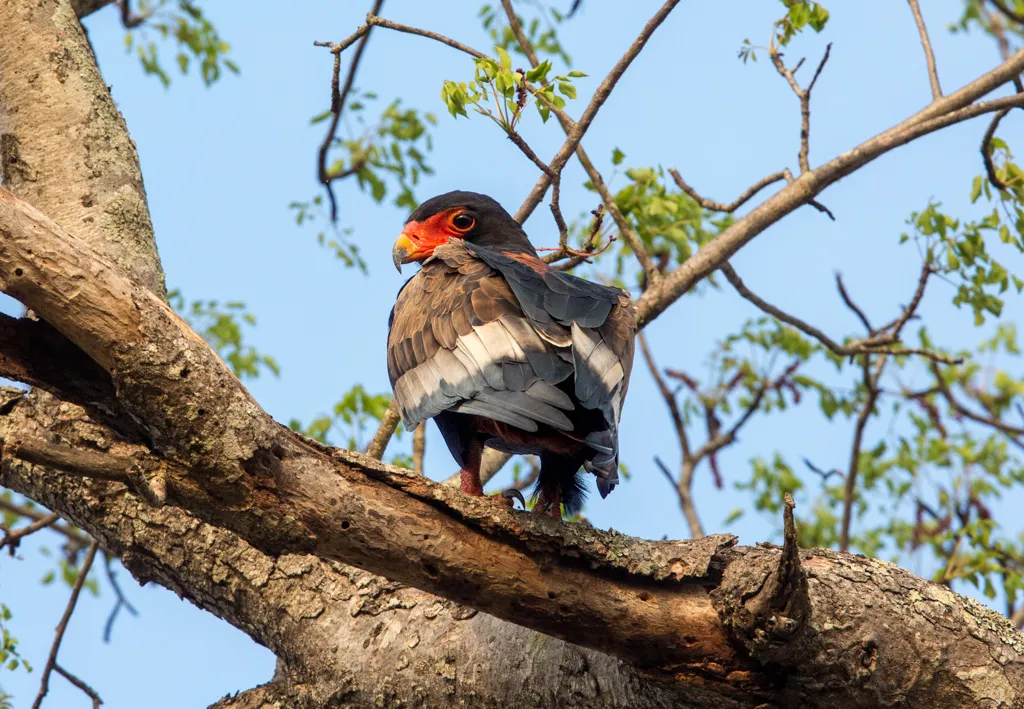
What makes the Bateleur Eagle special is the mix of colour, confidence and purpose. Perched in a tree, it looks almost formal, with dark body, grey shoulders, reddish bill and bright legs. In flight, the pattern changes. You see black, white and chestnut on the wings, a short tail, and that distinctive rocking motion that makes it easy to recognise even from a distance. Many guides can pick out a Bateleur Eagle from far away with one quick glance at the sky.
You will later remember the Bateleur Eagle as your “big sky bird.” While you watched elephants on the ground, this eagle traced its own path above, circling slowly over plains, woodlands and river valleys. When you think back to Africa, you do not picture only herds and predators. You also remember looking up and seeing this strong, coloured shape moving steadily across the open air.
The Bateleur Eagle Where to See It
The Bateleur Eagle lives across much of sub-Saharan Africa, especially in savannas and lightly wooded areas. You often see it soaring over open plains, scattered trees and dry riverbeds in the middle of the day.
Serengeti and Ngorongoro, Tanzania
Over Serengeti and the Ngorongoro highlands, Bateleur Eagles patrol above Wildebeest and Zebra herds, circling high, then gliding low along woodland edges and drainage lines.
Tarangire and Ruaha, Tanzania
In Tarangire and Ruaha, they glide over baobabs, sand rivers and mixed bush, often using rising warm air to gain height before drifting along elephant paths.
Recommended Safaris

5 Days
Private
5-Day Kahuzi Biega Congo Gorilla Trekking & Chimp Safari in Rwanda
from
$ 2500
per personMaasai Mara and Tsavo, Kenya
In Maasai Mara you see them above open grass and winding rivers, while in Tsavo they cross red soil plains and dry woodland, scanning for prey and carrion.
Queen Elizabeth, Murchison Falls and Kidepo, Uganda
Across Uganda’s savannas they appear above crater plains, river corridors and wide valleys, sometimes perching in tall trees that give them long, clear views.
Kruger and Hluhluwe–Imfolozi, South Africa
In Kruger and Hluhluwe–Imfolozi, Bateleur Eagles often ride thermals above mixed bush, then drop lower near roads and river systems where game and carcasses concentrate.
Chobe, Okavango and Moremi, Botswana
Around Chobe and the Okavango region they soar above mopane woodland and floodplains, watching both live prey and remains left by lions and wild dogs.
Hwange and Mana Pools, Zimbabwe
Over Hwange’s waterholes and Mana Pools’ riverine forests you see them gliding between pans and rivers, sometimes perching in tall trees above elephants and buffalo.
Etosha and Kgalagadi, Namibia and South Africa
In Etosha and Kgalagadi they cross bright pans and dry dunes, their dark wings and red faces standing out clearly against pale sky and salt-white ground.
Wherever you travel, a simple habit helps. Each time your vehicle stops, you look at the ground, then at the bushes, then at the sky. Sooner or later, that sky scan will reward you with the silhouette of a Bateleur Eagle crossing its own invisible route overhead.
The Bateleur Eagle Classifications
Class: Aves
Order: Accipitriformes
Family: Accipitridae
Genus: Terathopius
Species: Terathopius ecaudatus
Bateleur Eagle Gallery
The Bateleur Eagle Behaviour
When you watch a Bateleur Eagle in flight, you see why its name links to a performer. The bird uses a distinctive rocking motion, tipping slightly from side to side as it glides over the savanna. This movement is not random. Small wing adjustments help the eagle test air currents and keep balance as it searches for prey and carcasses across wide areas. That steady rocking shape becomes your easiest field clue once you learn it.
On the ground or perched, the Bateleur Eagle behaves very differently. It often chooses tall trees with clear views and strong branches, where it can rest, preen and scan the surrounding area. From there, it can notice other raptors, vultures and events on the plains. You might see a Bateleur Eagle sitting quietly, feathers slightly fluffed, then suddenly lean forward, spread its wings and launch toward something you cannot yet see. Only later does your guide point out the distant movement that triggered the response.
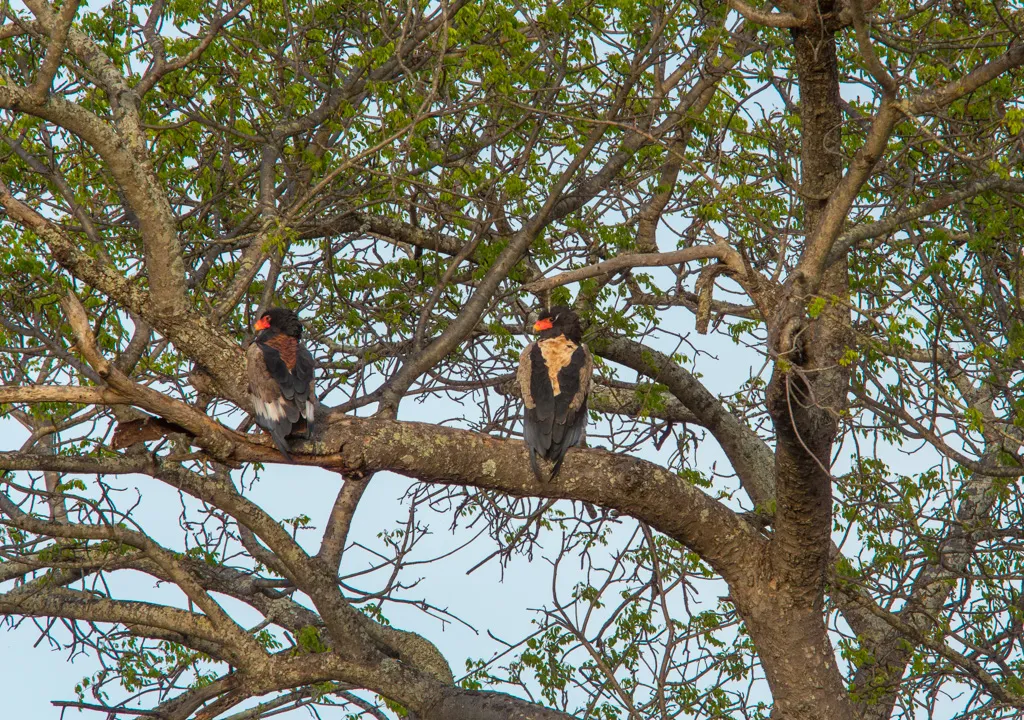
Communication involves posture, calls and aerial displays. Bateleur Eagles sometimes call with barking or yelping notes, especially near nests or during pair interactions. In the air, they may perform shallow dives, rolls and circling flights to strengthen pair bonds or signal territory. When two Bateleur Eagles fly together, you see a shared pattern, not a random meeting. They match height, distance and sometimes turn in parallel, like two dancers who know each other’s timing well.
Relationships are strongest within pairs. Bateleur Eagles are usually monogamous and defend territories over many years. They respond strongly to intruding raptors, sometimes chasing them with powerful, direct flight. At carcasses they can be assertive, driving away smaller birds or standing their ground against rivals. When you see that bright red face and firm stance near food, you understand that behind the graceful flight sits a bird fully prepared to fight for its space.
The Bateleur Eagle Diet
The Bateleur Eagle eats both live prey and carrion. It hunts small to medium sized animals, including birds, reptiles and mammals, such as pigeons, small bustards, lizards and rodents. In some areas it will also take young or weakened antelope, moving fast from the air when it spots a chance. This hunting style depends on wide, open views and strong eyesight, which is why you often see the bird soaring over open country rather than inside dense forest.
Carrion forms a significant part of its diet. The Bateleur Eagle locates carcasses by sight, watching for other scavengers and the shapes of dead animals on the ground. It may arrive early at fresh kills, feeding on softer parts before larger vultures gather. At older carcasses it works alongside other scavengers, using its strong bill to tear meat from remaining tissue. Watching a Bateleur Eagle feed at a carcass shows you that beauty in flight and toughness at the table can live in the same body.
The eagle also takes advantage of smaller food items, such as insects, termites and locusts, especially when they are abundant. After storms or in specific seasons, you might see it dropping to the ground repeatedly to pick up these small pieces of easy protein. All these choices together mean the Bateleur Eagle can adapt to changes in prey and season, as long as open space and enough food sources remain available in its territory.
The Bateleur Eagle Reproduction
Bateleur Eagles usually form long term pairs that hold territories for many years. Within these territories, they choose nesting sites high in large trees, often near the middle of their range. The nest is a platform of sticks lined with softer materials. Over time, it can grow in size as the pair adds new branches and repairs damage from wind and weather.
The female typically lays a single egg. Both parents share incubation, taking turns to sit while the other hunts and patrols. When the chick hatches, it depends completely on its parents for warmth and food. You might see one adult at the nest, feathers slightly lifted over a small, pale chick, while the other returns carrying food in its talons or beak.
Growth is slow compared to many smaller birds. The chick spends weeks in the nest before it can fly, and even after its first flights it still relies on the parents for feeding and guidance. This long, demanding process means each pair can raise only a limited number of young over many years. When you watch an adult Bateleur Eagle crossing the sky, you are looking at the result of a long investment of time and energy from its parents.
Recommended Safaris

4 Days
Private
4 Days Rwanda Gorilla Tour and Golden Monkey Trekking
from
$ 2500
per person
5 Days
Private
5-Day Kahuzi Biega Congo Gorilla Trekking & Chimp Safari in Rwanda
from
$ 2500
per personThe Bateleur Eagle FAQs
Why are they so colourful?
Bright red skin, black body and chestnut wing patches may help with display and recognition between partners. The colours also stand out clearly during aerial shows over open country.
For you, that colour mix turns every sighting into a strong visual memory, especially when the bird passes through clear blue sky or against pale afternoon clouds.
Is it rare?
In some regions numbers have dropped due to poisoning, habitat loss and reduced prey. In well protected parks you still see them regularly, especially when you remember to check the sky often.
Seeing a Bateleur Eagle in a strong protected system often means the area still holds enough prey, carrion and safe nesting trees for such a wide-ranging raptor.
Are they dangerous to people?
Bateleur Eagles are not a danger to people in vehicles or on normal walks. They stay at distance and focus on prey they can realistically handle in their talons.
The only risk would come from handling or disturbing nests, which you avoid by staying in vehicles and following guide advice. From that position, you are a quiet observer.
Best time of day?
Late morning and early afternoon often give good sightings, when warm air lifts and the Bateleur Eagle uses thermals to soar and patrol wide sections of its territory.
Early and late light also work, especially if you scan treetops near rivers and open plains where they like to perch before or after long flights across the savanna.
What does it eat?
The Bateleur Eagle eats small mammals, birds, reptiles and carrion, taking advantage of fresh kills and older carcasses. It also picks insects and other small items during seasonal peaks.
This flexible diet lets it switch between hunting and scavenging, which helps it cope with changing conditions across large, open territories.
How do pairs behave?
Pairs often fly together, circling and gliding in loose formation while calling or performing short display dives. On the ground they share nest duties and defend territory as a team.
When you see two Bateleur Eagles moving in close coordination, you are likely watching a bonded pair reinforcing their link and reminding neighbours of their presence.
Where should I look?
Look above open woodland, savannas and pans in major parks across East and Southern Africa, especially Serengeti, Maasai Mara, Kruger, Chobe, Hwange and Etosha.
As your vehicle moves, build a habit of scanning both far horizons and the space directly overhead. Many of your best Bateleur Eagle sightings will start that way.
Why does it have a tail short?
The short tail helps create a compact body that can respond quickly with wing adjustments. Combined with broad wings, it supports stable, controlled gliding over long distances.
For your eye, this tail shape gives an easy field mark. One glance at that shortened rear edge often tells you it is a Bateleur Eagle, even before colour details appear.
Conclusion
Spending time with the Bateleur Eagle shifts some of your attention from the ground to the air. You still care about lions, elephants and herds, but you start to listen when the guide stops talking and looks up. In that silence, a dark shape crosses the bright sky, rocks slightly, and keeps going, drawing a line you can almost feel.
For a traveler new to Africa, this bird often becomes the anchor for memories of heat, distance and light. You remember feeling the sun on your face while watching the Bateleur Eagle circle above a dry riverbed. You remember the red of its face and legs against a pale sky. You remember the moment when you realized that the savanna story does not only run on the ground.
Don’t wait,
book this adventure safari today
Low season
Oct, Nov, Mar, Apr, may
Peak season
Jun, July, Aug, Sept, Dec

Got any questions
about traveling to Uganda?
Get in touch.
