

Select Page
Warthogs: Facts, Classifications, Reproduction, Habitat, Diet and More
The Warthog Introduction
Your first warthog sighting often starts with a laugh you try to hide. You see a barrel shaped body, thin tail sticking straight up, and short legs running as fast as they can. It looks almost like a serious animal wearing a funny costume. Then you notice the tusks and the confidence, and your smile changes into respect.
If your idea of African animals comes mostly from big cats and elegant antelope, the warthog bends that picture. It kneels on its front legs to feed, snout buried in grass and soil, then pops its head up with a mouth full of roots and a face that seems built for trouble. You can almost hear it thinking about the next patch of food.
What surprises many people is how quickly you warm to warthogs. At first, they are “those funny pigs by the road.” Later, you remember a family trotting in single file, tails raised like thin flags, piglets trying hard to match their mother’s pace. You remember one standing at a burrow entrance, weighing you with dark, steady eyes before disappearing underground.
After a few days in the bush, warthogs become part of your mental map. You expect to see them near puddles, termitaria and short grass. You learn to look for knees rubbed bare from feeding, tiny piglets racing in full panic behind calm adults, and that quick drop to the ground when danger feels too close. Somewhere along the way, you find yourself a little protective of them.
The Warthog Classifications
Class: Mammalia
Order: Artiodactyla
Family: Suidae
Genus: Phacochoerus
Species: Phacochoerus africanus
Recommended Safaris

Where to See the Warthog
Warthogs live across much of sub-Saharan Africa wherever open savanna, grass, scattered trees and suitable burrows come together. You usually find them in national parks, community conservancies and even some farmland edges where grazing and soil suit their digging habits.
- Murchison Falls National Park, Uganda
You see warthogs around riverine grasslands, picnic sites and lodge lawns, often kneeling to graze or trotting away with tails up when vehicles approach a bit too close. - Queen Elizabeth National Park, Uganda
On Kasenyi plains and near the Kazinga Channel, warthogs share open areas with Kob and buffalo, using old burrows on gentle slopes as safe daytime hideouts. - Kidepo Valley National Park, Uganda
In Kidepo’s wide valleys, they root around dry grass and scattered shrubs, often near seasonal water points where other grazers gather in the early morning and evening. - Serengeti National Park, Tanzania
On the Serengeti’s open stretches and around scattered acacias, warthogs work the shorter grass. You sometimes see them near kopjes, vanishing quickly into rocky burrows. - Ngorongoro Crater, Tanzania
On the crater floor, warthogs kneel on rich grass pastures beside zebra and Wildebeest. From a distance they look almost like moving stones with tails. Close up, they feel much more alive. - Tarangire and Manyara, Tanzania
Around Tarangire’s riverine zones and in Lake Manyara’s open clearings, they graze, wallow in mud, and share dusty tracks with elephants and impala. - Maasai Mara National Reserve, Kenya
In the Mara, they appear along small streams and open plains, often with piglets. Lions and hyenas watch them closely, yet the warthogs rarely look intimidated for long. - Kruger National Park, South Africa
Warthogs become a regular roadside sight in Kruger. They graze in verges, dig beside old termitaria and suddenly drop to their knees when something tasty hides in hard ground. - Okavango, Chobe and other southern parks
Around floodplains and dry islands, warthogs mix water, grass and shelter in a very practical way, staying close to burrows and never far from their next digging spot.
Wherever you travel, you raise your chances if you slowdown in open savanna, look near old aardvark burrows and watch for small dust clouds where a snout works hard in the soil.
Warthogs Gallery

The Warthog’s Behaviour
If you give yourself time with warthogs, their behaviour starts to feel less comical and more carefully designed. They spend a lot of their day on their knees, front legs folded, pads on the wrists taking the weight while the snout pulls up grass, roots and bulbs. From far away they look clumsy. Up close, you see a very precise digging and clipping rhythm that turns poor patches of ground into real meals.
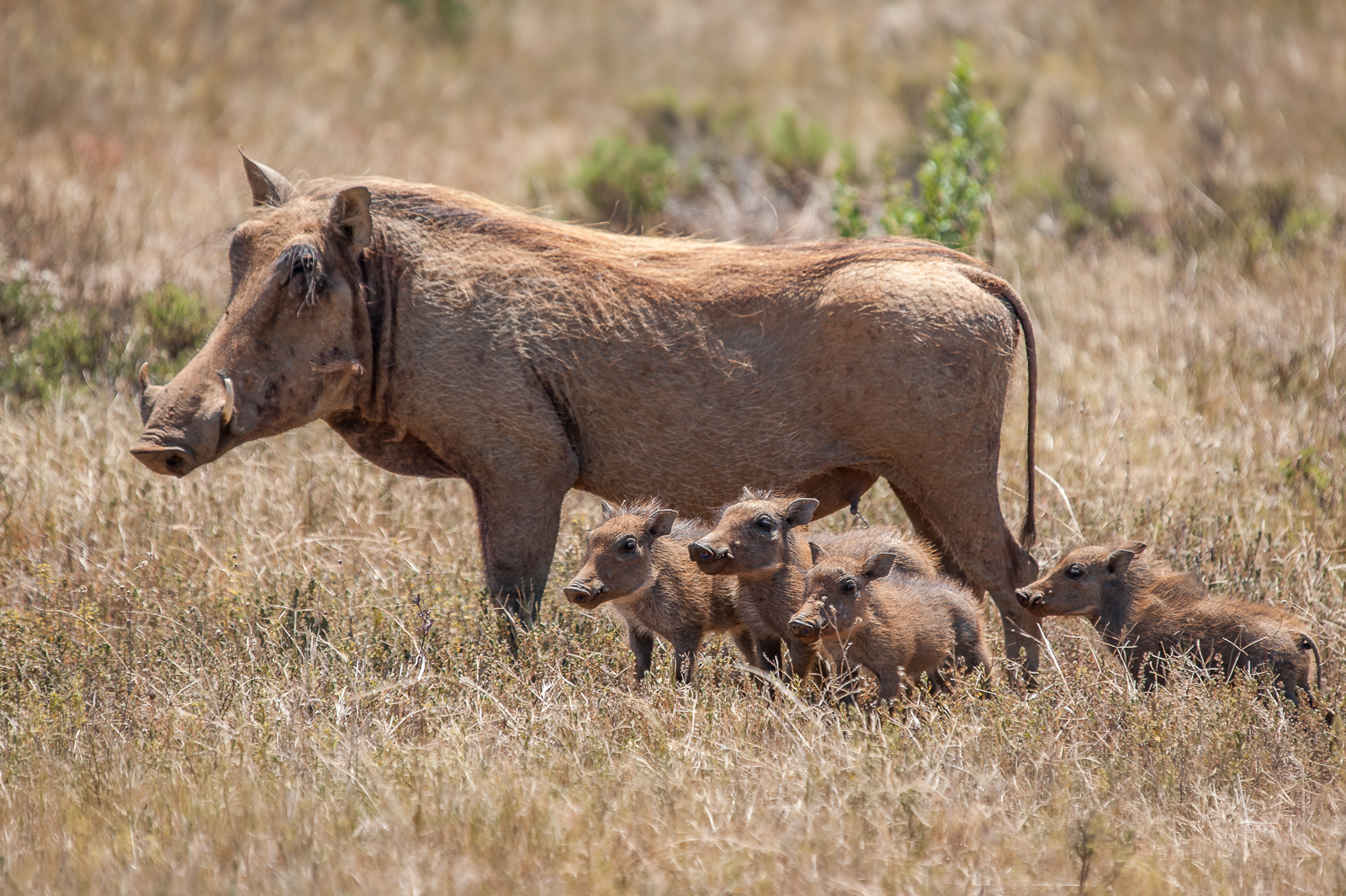
Warthogs live in small social groups called sounders, usually made up of females and their young. Adult males often move alone or join temporarily. Within a sounder, you see clear roles. One female keeps a slightly higher head position, checking for danger more often. Piglets learn quickly by copying, racing to new patches, then freezing when the adults stiffen and lift their heads. When alarm levels rise, everyone runs toward a familiar burrow, tails straight up like thin antennae transmitting urgency.
Burrows shape much of their daily behaviour. Warthogs rarely dig their own deep complexes from scratch. They prefer to take over old aardvark holes or other abandoned dens, backing into them rear first so they can face outward with tusks ready. Morning often begins with a cautious emergence, heads poking out one by one, sniffing and listening. Evening often ends the same way in reverse, with piglets diving in first and adults backing carefully after them.
Warthogs maintain a clear relationship with other animals. They give personal space to buffalo and elephants, move away from lions and hyenas quickly, and seem almost indifferent to impala and zebra grazing nearby. Around humans, they learn patterns. In some camps they treat vehicles as background objects, yet remain very alert to people on foot. Their behaviour reflects decades of testing which shapes are harmless and which shapes might mean trouble.
Daily rhythm tends to be strongly diurnal. Warthogs like daylight, especially in cooler hours. They feed in the early morning, rest near burrows or shade during the hottest part of the day, sometimes wallowing in mud to cool their skin, then feed again in late afternoon. At night they usually stay underground, trusting soil and narrow entrances more than the open dark where big predators patrol.
The Warthog’s Diet
The warthog diet centres on grasses, roots, bulbs and underground stems. They favour short grass, especially fresh regrowth after fire or rain, but they will kneel to feed on slightly taller patches when those offer better quality leaves. You see the snout move like a small plough, lifting clumps, shaking off soil, then chewing with steady, focused bites.
During dry seasons, warthogs dig deeper for roots and rhizomes. Those underground parts hold moisture and nutrients when the surface turns brown. You might watch a group working the same area for quite a while, each animal taking turns at promising spots. In some regions they also feed on fallen fruits and occasionally small animal matter if they find it, but plants remain the core of their menu.
Water matters, yet warthogs can cope for stretches without daily drinking if plants still hold enough moisture. Where waterholes or rivers sit nearby, they drink and wallow, turning damp edges into favourite places. Mud baths help them manage heat and parasites, and they often leave a wallow coated in a thick, cooling layer of drying soil that doubles as armour against biting insects.
The Warthog’s Reproduction
Reproduction in warthogs follows seasonal patterns tied closely to rainfall and food. In many areas, mating peaks toward the end of the dry season or early rains, so that births arrive when grass improves and mothers receive enough nutrition to support milk production. Timing shifts a bit with local climate, yet the general plan links piglets with greener months.
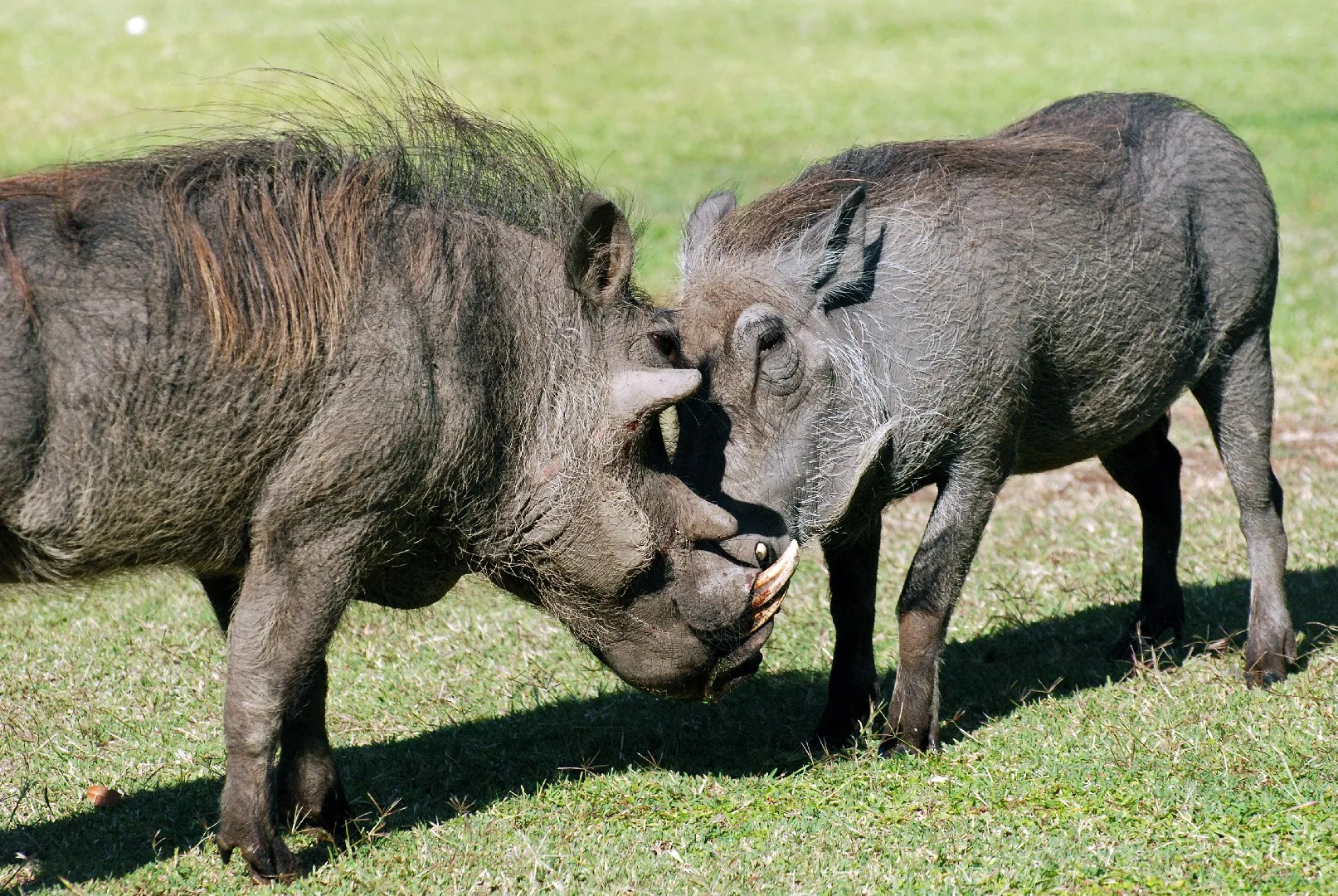
When a female comes into breeding condition, adult males pay attention. Boars assess each other with side by side walking, head swinging and tusk presenting. Fights can be serious, though many contests end with one male backing away before heavy contact. The facial “warts” and thick skin around the head help protect vital areas when tusks clash. You might see dust and hear heavy grunts, then watch one boar trot off as if that clear result was always expected.
After mating, gestation lasts several months. The female chooses and prepares a burrow, often repairing or slightly enlarging an existing one. She gives birth deep inside, where piglets stay hidden for the first weeks of life. During that time, she leaves to feed and drink, returning to nurse and clean them while keeping noise to a minimum.
As piglets grow stronger, they begin to follow their mother out of the burrow. The first days outside are full of nervous energy. Small bodies run in short bursts, then dive back inside at any sudden sound. Over time they grow braver, venturing farther from the entrance, learning where to feed and how to read their mother’s alarm signals. Eventually, they join the wider sounder routines, sleeping in shared burrows and feeding in loose lines across the grass.
Recommended Safaris

11 Days
Private
11 days Uganda Premium Gorilla, Wildlife & River Nile Adventure
from
$ 2900
per person
8 Days
Private
8 Days Murchison Falls, Gorilla, Chimpanzee & Queen Elizabeth Safari
from
$ 1790
per personThe Warthog FAQs
Are warthogs dangerous to people?
In most safari situations, warthogs prefer escape. They run toward burrows or open ground as soon as they feel unsure, especially when people approach on foot without warning.
They can charge with sharp tusks if cornered or handled badly, so you keep distance and follow guide instructions. From a vehicle, the risk stays very low and sightings feel comfortable.
Why do warthogs kneel when they feed?
Their necks are short compared with many grazers, and their snouts work best close to the ground. Kneeling brings mouth and nose to perfect digging and clipping height.
The thick pads on their wrists protect joints from rough soil and stones, so this position becomes practical rather than painful. It also gives them a very recognisable feeding style.
Do warthogs really live in holes?
Yes, burrows are central to warthog life. They use them for sleeping, hiding from predators and raising piglets, relying on underground safety when the savanna feels too risky.
They usually back into the burrow so tusks face outward. That way, any predator trying to enter meets a set of serious weapons instead of a vulnerable rear end.
What predators usually hunt warthogs?
Lions, leopards, hyenas and wild dogs all hunt warthogs. Young piglets also face threats from eagles and smaller predators when they stray too far from adult protection.
Burrows and awareness help balance that risk. A warthog that reaches its hole in time becomes much harder to catch than one still feeding far out on open grass.
Why do warthogs raise their tails when they run?
Raised tails act like visual beacons. In tall or uneven grass, group members, especially piglets, can follow those thin lines and avoid losing contact during sudden escapes.
It may also confuse predators slightly, drawing eyes toward moving tails rather than the exact body position. Either way, it has become a clear part of their alarm behaviour.
Do warthogs eat meat or only plants?
They mainly eat grasses, roots and bulbs. From time to time they may nibble carrion or small animal matter, but plants remain their core energy source throughout the year.
Their snouts and teeth suit digging and grinding vegetation more than tearing flesh. You will usually watch them grazing quietly rather than competing at carcasses.
Are warthogs active mostly during the day or at night?
They prefer daylight, especially early morning and late afternoon. Those cooler hours let them feed comfortably while still keeping an eye on predators in open country.
At night they usually stay underground, resting in burrows. In areas with strong human disturbance, some may shift slightly, but the general pattern stays strongly tied to daytime activity.
Can warthogs and people share the same areas peacefully?
In many rural regions, warthogs graze near fields and community lands without constant conflict, feeding on wild plants and retreating to burrows when people appear.
Problems arise when they damage crops or when hunting pressure rises. Good management tries to keep space for both farmers and warthogs, balancing food security and wildlife value.
Conclusion
Spending time with warthogs changes how you feel about “small” sightings on safari. They stop being background shapes beside the road and start looking like families doing their best in a world of big teeth and changing seasons. You see hard soil, scarce grass and narrow burrows differently once you picture those places as home.
You remember the way one sounder stepped out of a burrow at first light, steam rising from their bodies in cool air. You remember piglets sprinting with wild confidence, then vanishing underground in a flash when a vulture’s shadow passed overhead. You remember a lone boar standing firm for a moment, tusks bright, before jogging away with a strange, stubborn pride.
Later, when someone asks you which animals surprised you, you may mention lions and elephants first. Sooner or later, though, you will probably smile and talk about warthogs. About tails that turn into flags, knees that never seem to complain, and faces that made you laugh before they made you think.
Browse other sightings
Don’t wait,
book this adventure safari today
Low season
Oct, Nov, Mar, Apr, may
Peak season
Jun, July, Aug, Sept, Dec

Got any questions
about traveling to Uganda?
Get in touch.
