

Select Page
Thomson’s gazelle: Facts, Classifications, Reproduction, Habitat, Diet and More
The Thomson’s Gazelle Introduction
Your first real meeting with a Thomson gazelle often happens so quietly you almost miss it. The vehicle stops, your eyes chase elephants or lions in the distance, and then a slim, tan body with a clean black side stripe steps into view. For a moment the plains shrink, and your focus drops to this small, alert antelope standing ankle deep in grass.
At first glance, the Thomson’s gazelle looks light and almost fragile. A white belly, warm brown back, dark stripe along the side, and those neat, curved horns that rise like careful lines drawn against the sky. Then you watch the face. The eyes stay busy, ears flick, nostrils test the air. You realise this is an animal that reads its world every second, because it has to.
What makes the Thomson’s gazelle so memorable is the blend of grace and tension in every movement. One moment it grazes calmly beside others, heads down, tails twitching. The next, a shape or sound you barely noticed sends a wave of stotting bodies bouncing across the grass, all four legs stiff and springing as if the ground suddenly turned hot. You feel the energy of a life that can switch from quiet to flight in a heartbeat.
Later, when you think back on your safari, the Thomson’s gazelle often returns as a background actor that quietly stole a few scenes. You remember the narrow face turning toward a distant cheetah, the sudden dance of sharp turns and leaps, and the small relief you felt each time a group somehow slipped away and went back to feeding
The Thomson’s Gazelle Classifications
Class: Mammalia
Order: Artiodactyla
Family: Bovidae
Genus: Eudorcas
Species: Eudorcas thomsonii
Recommended Safaris

14 Days
Private
14-Day Uganda, Congo & Rwanda Gorilla Trekking & Wildlife Safari
from
$ 4900
per personWhere to See the Thomson Gazelle
Thomson’s gazelles prefer open short grass plains and lightly brushed savanna in East Africa, especially where grazing stays fresh with constant predator presence. They like space where they can see trouble coming, but also enough cover for young to hide.
You can picture them clearly in places such as:
Serengeti National Park, Tanzania
On the southern and eastern plains, large herds scatter across the grass, dotted between Wildebeest and zebra. During the green season, Thomson’s gazelles turn whole horizons into a living, moving pattern.
Ngorongoro Conservation Area, Tanzania
On the crater floor and outer plains, they graze in mixed herds, often close to lions and hyenas. That closeness gives you many moments where calm feeding and real danger share the same frame.
Loliondo and surrounding Maasai lands, Tanzania
Outside park boundaries, they feed on community rangelands, sharing ground with Maasai livestock. You see them near cattle and goats, switching between wild and pastoral scenes with no problem at all.
Maasai Mara National Reserve, Kenya
Here they stand shoulder to shoulder with Grant’s gazelles, topi and Wildebeest. Gentle ridges and open flats give perfect visibility, and Thomson’s gazelles seem to be almost everywhere the grass is short.
Nairobi National Park, Kenya
On these city edge plains, you can watch them graze with skyscrapers in the distance. It feels slightly strange and quietly impressive that such a classic wild antelope still lives beside a capital city.
Amboseli ecosystem, Kenya
Around Amboseli and nearby conservancies, they move between dusty grasslands and seasonal wetlands, using any green patches that appear after rainfall and keeping a cautious distance from lions and cheetahs.
Wherever fresh short grass appears after rain or fire, you have a fair chance of finding Thomson’s gazelles using it, turning new growth into the energy they need for constant vigilance and quick flight.
The Thomson’s Gazelle’s Behaviour
If you stay with a herd of Thomson’s gazelles long enough, their behaviour starts to layer. At first you see a loose group, heads down, all doing roughly the same thing. Then patterns emerge. Some individuals keep feeding with very little pause. Others lift their heads every few seconds, scanning, ears turning toward distant calls or engine sounds. There is always at least one animal acting as an early warning system, even when everyone looks relaxed.
Their social structure is flexible. In many areas you see mixed herds of females, young and a few subadult males. Territorial males often hold patches of prime grazing, chasing rivals away with short chases, head swinging, and horn gestures that stop just short of full contact. During some seasons, especially when migration herds pass through, boundaries blur and you see huge gatherings where many of these small antelope move like a living carpet over the plains.
Thompsons's Gazelle Gallery

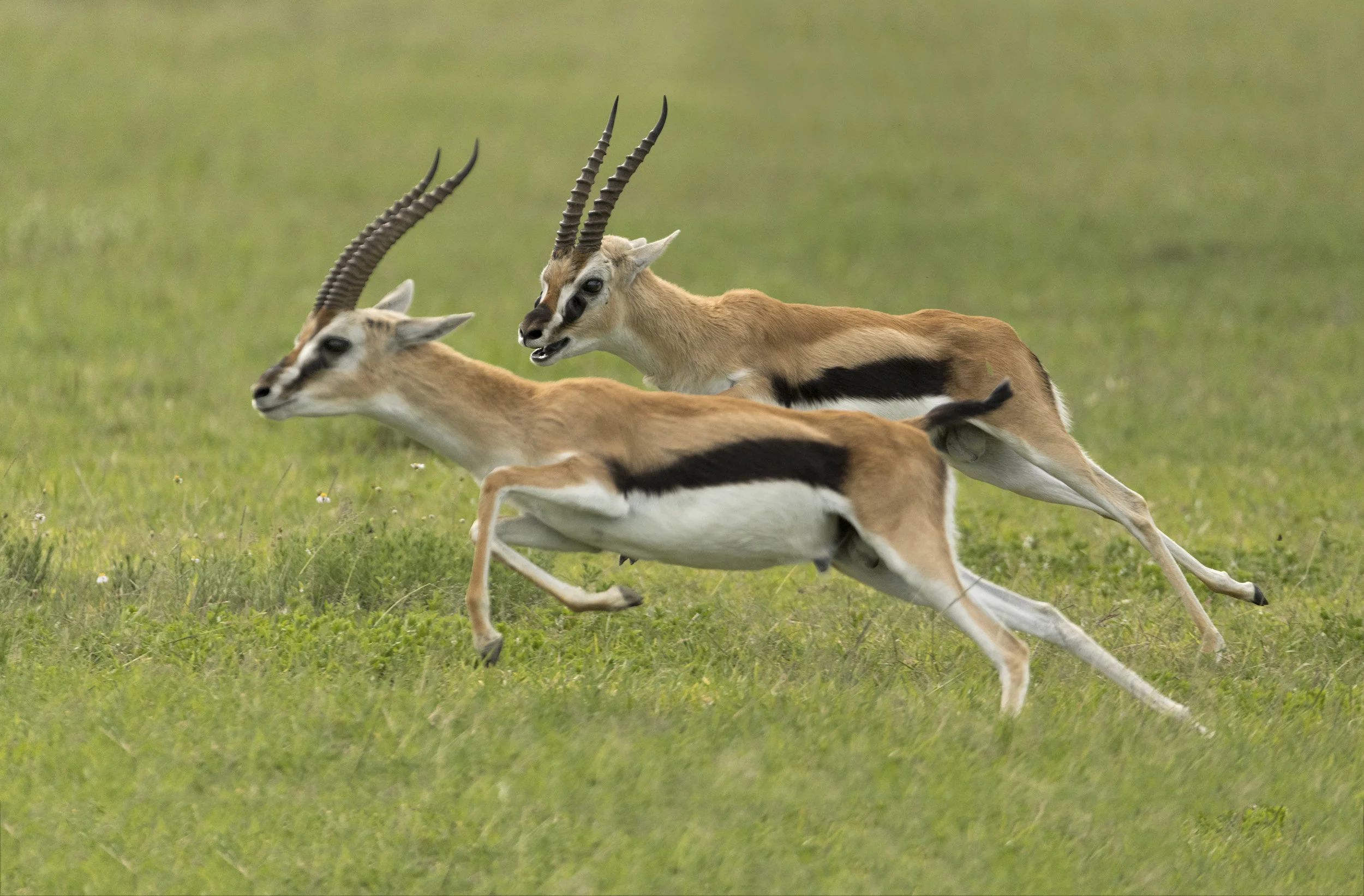
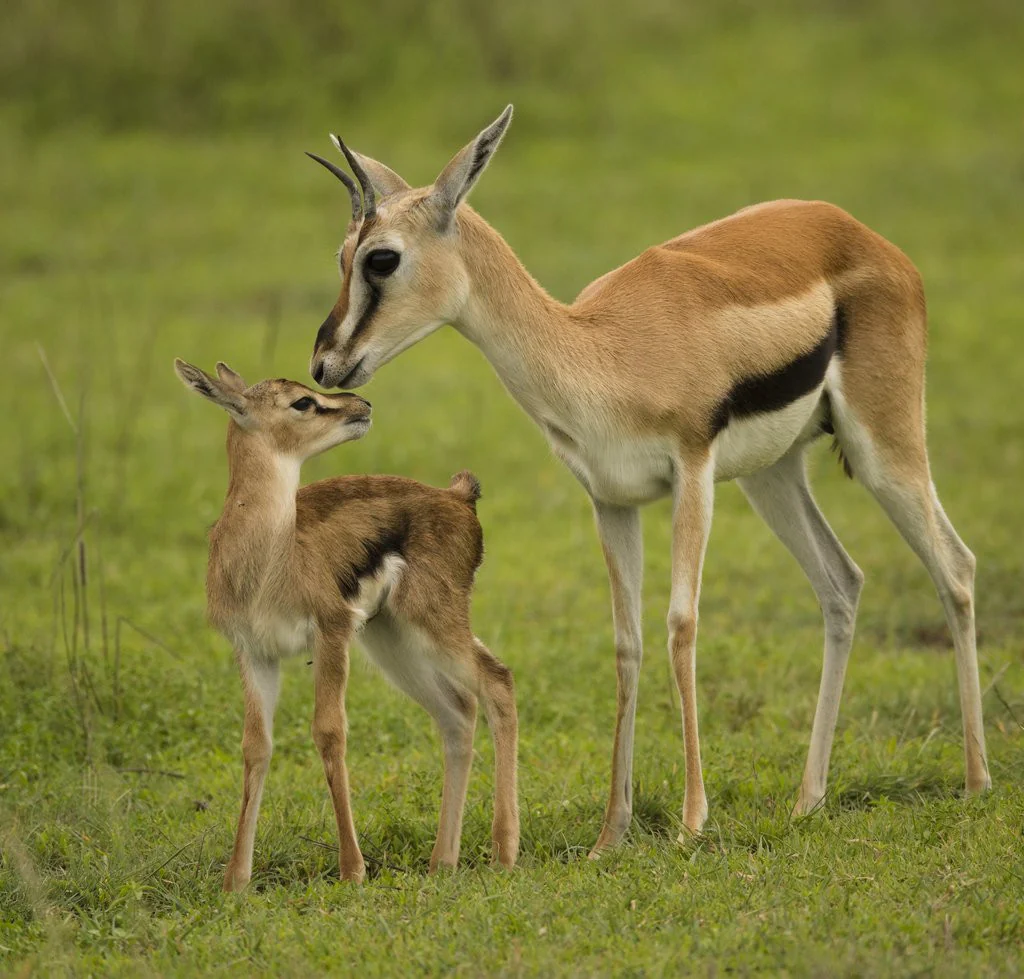
When danger appears, behaviour changes fast and in stages. A head lifts, a tail flicks, a few animal’s freeze. Then one breaks into that stiff legged bounce, and others follow. This stotting, with all four legs straight and body lifted in clean arcs, probably sends two messages at once. It tells predators that the gazelle has seen them and is fit enough to waste energy on showy jumps, and it keeps the group visually connected in tall grass. To watch a whole herd burst into this strange, beautiful run is to feel tension and admiration at the same time.
Communication flows through posture, scent and small sounds. A male marking grass tufts with scent underlines his claim without constant fighting. Mothers and young recognise each other by call and smell even in busy herds. When wind carries predator scent, the entire herd seems to lean slightly away, bodies turning almost as one unit. You realise that most of their decisions happen in these almost silent exchanges rather than in dramatic moments.
Daily rhythm follows light and temperature. Thomson’s gazelles feed most in the cooler hours of morning and late afternoon, when plants hold more moisture and predators are easier to see. Around midday they rest more, standing or lying in scattered shade if they can find it, chewing slowly and saving energy. Even then, you rarely see them fully switch off. A sudden shadow or call can bring many animals to their feet in seconds.
The Thomson’s Gazelle’s Diet
The Thomson’s gazelle’s diet is centred on grass. They prefer short, green shoots that appear after rain, especially on recently grazed or burned areas where fresh growth is rich and easy to reach with small mouths. You see them clip grass close to the ground, moving steadily with each step, turning whole patches into neat, low lawns.
They choose quality over quantity. Rather than eat tall, rough stems, they pick the softest parts, often following larger grazers that first open up the sward. Behind Wildebeest and zebra herds, Thomson’s gazelles move in to take advantage of the new, tender growth the big animals stimulate. In a sense, they specialise in finishing what others started, turning the second wave of grass into their main energy source.
In dry times, they accept slightly tougher grasses and occasional forbs and herbs when these offer more nutrition than old stems. Moisture from plants helps reduce daily dependence on open water, although they still drink when they can. This selective yet flexible feeding style helps them cope with a moving, seasonal world where grass quality shifts quickly.
The Thomson’s Gazelle’s Reproduction
Reproduction in Thomson’s gazelles follows seasons of grass and movement. In many areas births peak when young grass is abundant, giving mothers enough energy to produce rich milk and offering fawns good cover and feeding conditions as they grow. The exact timing can vary with local rainfall, but the link between new grass and new life stays strong.
Males establish and defend small territories on good feeding ground, especially during mating periods. You see them stand with heads high, neck slightly arched, horns forward. When another male enters, the owner crops grass in a focused way, flicks his tail and sometimes performs stiff legged walks or short chases. Actual horn clashes do happen, but often the display, combined with clear scent marking, is enough to convince an intruder to drift away.
When a female comes into estrus, the territorial male follows her, sniffing, doing short prancing steps and trying to position himself slightly in front. Mating itself is quick and unshowy, often happening almost unnoticed in the middle of ordinary feeding. After that, the female carries a single fawn for several months before seeking a birth spot slightly apart from the herd, usually in thicker grass or gentle hollows where the newborn can hide.
For the first days and weeks, the fawn spends much of its time lying still, pressed into the cover, its coat blending with stems and shadows. The mother returns at intervals to nurse and clean it, keeping visits short to avoid drawing attention. As strength improves, the young gazelle begins to follow the mother for short distances, then longer, joining the herd more fully. Watching a fawn take its first bouncing runs beside adults can feel surprisingly moving after you have pictured all the dangers it has already avoided.
Recommended Safaris

8 Days
Private
8 Days River Nile, Murchison Falls & Kidepo Wilderness Safari
from
$ 2400
per person
11 Days
Private
11 days Uganda Premium Gorilla, Wildlife & River Nile Adventure
from
$ 2900
per personThe Thomson’s Gazelle FAQs
How big is a Thomson’s gazelle in real life?
A Thomson’s gazelle is small compared with many savanna antelope. Adults reach roughly knee height to a tall person and weigh far less than a zebra or Wildebeest.
That size means they live in a more delicate world. Grass that barely reaches your shin can feel like a tall structure to them, with cover, paths and danger all hiding inside it.
How can I tell a Thomson’s gazelle from a Grant’s gazelle?
Thomson’s gazelles have a clear black side stripe and a distinctive pattern on the rump, with the white patch not wrapping far above the tail compared with Grant’s.
Grant’s gazelles are larger, with longer horns and more extensive white on the rump. In mixed herds, size, stripe and rump pattern are the main clues your eye learns to use.
Are Thomson’s gazelles easy to see on safari?
In the right parks and seasons, yes. On Serengeti and Mara plains they are among the most common antelope, especially where grass is short and fresh.
You often see them as part of the bigger picture first, then your guide starts pointing out behaviours, differences in horn shape and the delicate patterns between individuals.
What predators hunt Thomson’s gazelles most often?
Cheetahs are classic hunters of Thomson’s gazelles, using speed and surprise over short distances. Lions, leopards, hyenas and wild dogs also take them when chances appear.
For fawns, smaller predators and raptors also matter. That is why hiding, stillness and choosing good cover are such important parts of a young gazelle’s first weeks.
Why do Thomson’s gazelles move with the Wildebeest migration?
They follow the same broad pattern because they want the same thing: short, nutritious grass. When Wildebeest and zebra open up new growth, Thomson’s gazelles use the fresh, low regrowth behind them.
This shared movement puts them near many predators, so risk rises, but the food rewards are high enough that the pattern remains worthwhile for the species as a whole.
Do both male and female Thomson’s gazelles have horns?
Yes, both sexes usually carry horns, though male horns tend to be thicker, longer and more strongly curved. Female horns are often finer and slightly shorter.
In herds you can often pick out mature males by a combination of horn shape, posture and behaviour, especially if they defend small territories or follow females closely.
Are Thomson’s gazelles active mostly during the day or at night?
They are mainly diurnal, with peak activity in early morning and late afternoon when temperatures are kinder and visibility is better.
They still move at night, especially in bright moonlight, but they rely heavily on sight, so daylight hours remain crucial for feeding and social interactions.
Why are Thomson’s gazelles important in the ecosystem?
They convert grass into energy that feeds many predators, from cheetahs to hyenas. In that sense they are a key link between plants and large carnivores on the plains.
Their grazing behaviour also shapes plant patterns, maintaining short grass patches that attract other animals and help keep a mosaic of different grass heights across the savanna.
Conclusion
Spending time with Thomson’s gazelles softens and sharpens your view of the plains at the same time. You stop seeing the grass only as a stage for lions and start noticing all the smaller lives that make the whole system work. A slim antelope that many visitors overlook becomes a constant presence in your memories.
You remember the way a herd seemed to glow in evening light, side stripes forming fine lines across the landscape. You remember that moment of shared tension when a cheetah appeared and every gazelle froze, then sprang into motion. You remember a lone fawn standing in slightly taller grass, trusting stillness more than speed for a few fragile minutes.
Don’t wait,
book this adventure safari today
Low season
Oct, Nov, Mar, Apr, may
Peak season
Jun, July, Aug, Sept, Dec

Got any questions
about traveling to Uganda?
Get in touch.
