

Select Page
Cheetah: Facts, Classifications, Speed, Habitat, Diet and More
The Cheetah Introduction
Your first real Cheetah sighting often feels strangely quiet. No roaring, no dust storm, no drama at first. You notice a slim, spotted body on a termite mound, head up, tail hanging, eyes scanning. It looks more like a runner catching breath than a classic “big cat.”
If you come from a city in America or Europe, you probably grew up thinking of the Cheetah as “the fast one.” That label is true, but it is also incomplete. In front of you sits an animal that spends far more time watching, waiting and thinking than it does sprinting. The speed sits underneath all that patience like a loaded spring.
What makes the Cheetah feel different from lions and leopards is the mood around it. A Cheetah on a rise looks thoughtful. It studies gazelles, sizing distances and wind direction. It shifts position a little, lies down, sits up again. You sit in the vehicle, feeling the same hesitation you feel before a big decision, because you know that when this cat finally commits, everything will happen faster than your camera brain can process.
Many travelers end up remembering Cheetahs as the animals that made them lean forward in their seats without noticing. Not only during the chase, but during the long, tense minutes before. One slim cat walking through pale grass with its tail tip twitching can hold more attention than an entire herd if you let it.
Where to See Cheetahs
Cheetahs live in open savannas, semi open bush and some desert edges, where they can see and run. You mostly find them where grass is short enough to spot and stalk without losing speed.
Serengeti National Park, Tanzania
On Serengeti’s wide plains, Cheetahs work the open grass around Thomson’s gazelles, often using low termite mounds as lookouts before slipping down to start a stalk.
Ngorongoro Conservation Area and Ndutu, Tanzania
Around Ndutu in the calving season, Cheetahs follow young Wildebeest and gazelles, moving between small woodlands and open flats that give them room to sprint.
Tarangire and Ruaha, Tanzania
In these parks you may find Cheetahs in more broken country, using scattered bushes and rocky outcrops as cover while they watch impala and smaller antelope below.
Maasai Mara National Reserve, Kenya
In the Mara, Cheetahs often patrol gently rolling grasslands, sometimes standing on old termite mounds or even vehicle roofs when used to cars, scanning for any sign of weakness.
Laikipia and Samburu regions, Kenya
On some Laikipia ranchlands and pockets of Samburu, Cheetahs work lighter bush and open patches, threading between herds and cattle tracks with little wasted movement.
Recommended Safaris

14 Days
Private
14-Day Uganda, Congo & Rwanda Gorilla Trekking & Wildlife Safari
from
$ 4900
per personKidepo Valley and other open areas, Uganda
In places like Kidepo, Cheetahs appear on wide, open valley floors, working edges of grass and sparse trees where Uganda’s northern plains feel broader than you expected.
Etosha National Park, Namibia
Around Etosha’s white pan and surrounding plains, Cheetahs use low shrubs and termite mounds as cover, often seen near springbok herds and smaller waterholes.
Kgalagadi Transfrontier Park, South Africa and Botswana
In Kgalagadi, Cheetahs follow dry riverbeds and dune valleys, using low grass and scattered bushes to launch fast, clean runs against springbok and other medium prey.
Kruger and private reserves, South Africa
In Kruger and some neighbouring reserves, they keep to more open zones and old clearings, moving between thickets and roads while trying to avoid heavier, stronger competitors.
Wherever you go, your chances improve when you spend unhurried time in open, gently rolling country, especially in cooler hours when Cheetahs feel more comfortable moving and testing possible targets.
The Cheetah Classifications
Class: Mammalia
Order: Carnivora
Family: Felidae
Genus: Acinonyx
Species: Acinonyx jubatus
The Cheetah’s Behaviour
Cheetahs are built for the sprint, yet most of their day is slow. You see a Cheetah sitting upright in short grass, head turning, ears twitching, every sense tuned to movement in the middle distance. It walks a little, pauses, lies down, then sits again. That stop start rhythm is its way of saving energy for the few seconds when it will need everything.
They are mostly active in the cooler hours, especially morning and late afternoon, and sometimes through gentle midday when clouds soften the heat. Part of this is comfort, part is strategy. Hunting when lions and hyenas are less active gives Cheetahs a slightly better chance to keep their kill for longer than a few minutes. They are fast, yet they are not built for big fights, so timing matters.
Social life feels more flexible than many people expect. Adult females are usually solitary, apart from their cubs. They move with their young, teaching them to stalk, chase and read the mood of a herd. Male Cheetahs often form coalitions, usually brothers from the same litter. A coalition walks with a certain confidence, marking trees together and working as a team to control a small but valuable hunting area. A single male looks cautious. Two or three moving together feel like a small, quiet unit with clear plans.
Communication uses scent, posture, and a gentle set of sounds that migt surprise you. Cheetahs chirp and purr more than they roar. Mothers call cubs with high, birdlike notes. Coalition members greet with soft contact, rubbing and short vocalisations rather than dramatic displays. When you are close enough to hear that, and you probably will be at some point, the idea of a “fearsome” Cheetah shifts into something more layered.
Cheetah Gallery


The Cheetah’s Diet
The Cheetah’s diet centres on small to medium antelope. Thomson’s and Grant’s gazelles, impala, springbok and similar species sit near the top of the menu. Cheetahs look for individuals that are distracted, slightly separated, young or simply unlucky in where they happen to be standing. They are not trying to prove anything. They are trying to eat without breaking themselves in the process.
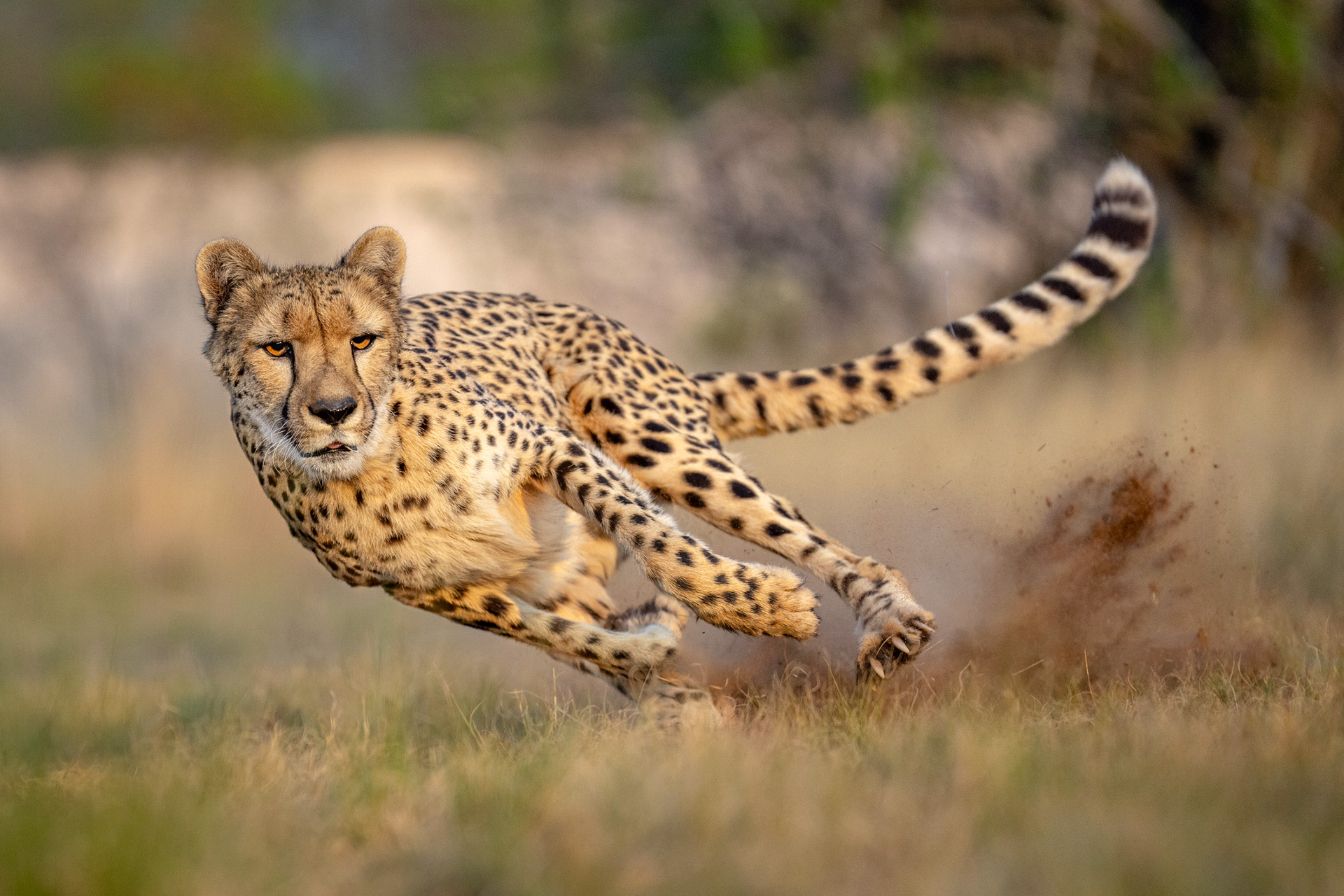
Hunts usually start with a careful stalk. The Cheetah uses small rises, clumps of grass and the curve of the ground to stay out of clear view. It moves low, shoulders flowing smoothly, tail balancing each step. Only when the distance feels right, and the prey looks distracted or busy, does the cat commit. The sprint that follows can reach very high speeds for short bursts, but it rarely lasts long. Fifteen or twenty seconds can decide everything.
If the Cheetah succeeds, it must recover quickly, breathing hard, body hot. You might see it drag the prey to a bit of cover and look around constantly while panting. The kill is really only half the problem. Lions, hyenas and even bold jackals may try to steal it. Sometimes the Cheetah has to abandon the meal entirely and walk away, which feels unfair when you have watched all the effort, but that is the tradeoff for being fast rather than heavily built.
The Cheetah’s Reproduction
Reproduction in Cheetahs begins with females calling and leaving scent marks when they are ready to mate. Males in the area pick this up and follow, sometimes competing lightly, though serious fights are costly for a body designed more for running than wrestling. Once a pairing forms, the visible moment for visitors is often brief or missed completely, hidden in grass or behind a rise.
After mating, the female carries the future litter alone. Gestation lasts around three months, ending with the birth of usually three to five cubs in a hidden den. She chooses cover, sometimes in long grass, sometimes in thick shrubs or low rocky spots. Cubs arrive blind and helpless, covered in fluffy fur with a silvery mantle along the back that may help break their outline in grass. Their survival depends on her decisions and her luck.
For the first weeks she moves them regularly. Dens shift as she tries to avoid building a pattern those predators learn. When you hear that Cheetah cub survival rates can be low in some areas, this is one reason. Lions, hyenas and even large eagles can threaten young cubs. Later, when you see half grown cubs playing in the open, you are looking at a small, stubborn success story.
As the cubs grow, the mother introduces them to hunting step by step. At first, they watch from a distance. Then she brings live, weakened prey for them to practice on. You see awkward chases, missed pounces, too much play, then slowly more control. When she finally leaves them to live independently, they carry those lessons into a world that will not forgive many mistakes.
Recommended Safaris

11 Days
Private
11 days Uganda Premium Gorilla, Wildlife & River Nile Adventure
from
$ 2900
per person

The Cheetah FAQs
How fast is a Cheetah?
A Cheetah can reach very high speeds over short distances, close to highway speeds, though real hunts rarely stay at the maximum for long because the body heats quickly.
In the field, acceleration and turning matter more than raw numbers. The speed off the mark and the ability to change direction make escape very difficult for chosen prey.
Are Cheetahs dangerous to people?
In wild settings, Cheetahs tend to avoid direct conflict with humans. They are lighter than lions and built for chase, not heavy fighting, so they gain little from confronting a large, upright figure.
From a vehicle, you often see them quite relaxed, especially in parks where cars behave predictably. The main rule is simple. Stay inside the vehicle, keep calm, and let the cat decide the distance.
When is the best time to see Cheetahs?
You stand a good chance in early morning and late afternoon, when temperatures are kinder and prey is active. Many guides also watch them through gently overcast midday when sun intensity eases.
Night is less useful for Cheetahs compared with lions or leopards. They rely more on sight and prefer enough light to judge distances clearly, so you mostly meet them in daytime hours.
Where are Cheetahs easiest to find?
Open savanna parks with strong gazelle or small antelope populations provide some of the best chances. Serengeti, Maasai Mara, Ndutu, Etosha, Kgalagadi and some private reserves often feature here.
Within a park, guides focus on gently rolling, open ground with scattered cover rather than thick bush. Once you know that pattern, you start recognising “Cheetah friendly” areas on each drive.
Do Cheetahs live in groups?
Female Cheetahs are usually alone with their cubs. Adult males often form coalitions, commonly brothers from the same litter, and those small groups can hold territories quite effectively.
A coalition shares patrol duties, hunts together and offers backup when threats appear. Seeing two or three males walk side by side across a plain has a very particular, confident feeling.
Why do Cheetahs lose kills so often?
Cheetahs are fast, but they are not heavily built. After a sprint, they are hot and tired, which leaves them in poor shape for a serious fight with larger predators.
Lions, leopards and hyenas read this quickly. Stealing a fresh Cheetah kill is often easier than hunting, so Cheetahs sometimes abandon food rather than risk injury that might end their hunting future.
How do Cheetah cubs learn to hunt?
Cubs begin by watching their mother stalk and chase from safe distances. They copy her low walk, her pauses and the way she uses cover, even if they do not get everything right at first.
Later she brings live prey with weakened strength, giving the cubs a chance to practice real pounces and bites. Those clumsy early attempts slowly become more focused, and one day she simply does not return.
Why are Cheetahs at risk in the wild?
Cheetahs face shrinking space, conflict with livestock farmers, competition from stronger predators, and illegal trade in cubs. Their need for large, open territories makes them sensitive to fencing and busy human areas.
Protected parks, community areas and careful tourism help. Each time you choose a responsible operator, you add a small piece of pressure in favour of keeping those open spaces viable
Conclusion
Spending time with Cheetahs changes how you feel about speed. You realise it is not only about numbers or bragging rights. It is about patience, risk, timing and the quiet weight of every decision. One wrong burst at the wrong moment costs energy, comfort and sometimes even survival.
For a traveler who arrives thinking only of “the fastest land animal,” this deeper view can be moving. You remember the chase, of course, if you see one. Yet you also remember the long minutes before, the small tail flicks, the way the cat waited for the herd to shift slightly. You remember the heavy breathing afterward, and maybe the frustration when hyenas arrived.
Don’t wait,
book this adventure safari today
Low season
Oct, Nov, Mar, Apr, may
Peak season
Jun, July, Aug, Sept, Dec

Got any questions
about traveling to Uganda?
Get in touch.
