

Select Page
Nile crocodile: Facts, Classification, Reproduction, Habitat, Diet and More
The Nile Crocodile Introduction
Your first real encounter with a Nile crocodile rarely happens in the middle of the river. It usually starts with a shape that seems like a log on the bank, still and harmless, until someone quietly points out the eyes. The head lifts a fraction, the jaw opens just enough to show heavy teeth, and the picture of the river in your mind changes.
If you grew up with crocodiles as movie monsters, the Nile crocodile feels strangely quieter in real life. It lies half in water, half on mud, letting the sun warm its back. A heron walks nearby. Antelope drink a few metres upstream. Nothing dramatic happens for long minutes. Then a fish jumps, or a bird lands a little too close, and that lazy stillness turns into fast, exact movement. You blink and the moment is already finished.
What makes the Nile crocodile so striking is the mix of age and patience you feel when you watch it. This is one of Africa’s oldest-looking predators, built on a design that worked long before people started naming rivers. You sit in a boat or stand on a bank, looking at the rough armour plates, the scarred tail, the long jaw, and you sense how many seasons that animal has already survived.
Many travelers remember their first Nile crocodile not for an attack, but for a stare. The water is quiet, the engine is idling low, and the crocodile rises slowly until the eyes and nostrils break the surface. It watches you as calmly as if you were another hippo or tree. That steady, unreadable gaze stays with you long after the boat moves on.
Recommended Safaris

5 Days
Private
5-Day Kahuzi Biega Congo Gorilla Trekking & Chimp Safari in Rwanda
from
$ 2500
per person
The Nile Crocodile: Where to See It
Nile crocodiles live anywhere that offers permanent or seasonal freshwater across a wide part of sub-Saharan Africa. You find them in big rivers, lakes, swamps, dams, and even some coastal estuaries. On safari, you start seeing patterns; every place where water gathers and animals drink becomes potential crocodile country.
- Murchison Falls and the Victoria Nile, Uganda
Along this stretch of the Nile, Nile crocodiles bask on sandy banks, rest on flat rocks, and patrol the edges where hippos surface and buffalo come to drink below steep cliffs. - Kazinga Channel and Lake Edward, Uganda
On boat cruises between the lakes in Queen Elizabeth National Park, crocodiles lie on mud bars beside yawning hippos, turning every quiet corner into a place where something sharp might be waiting. - Lake Mburo and smaller Ugandan lakes
Around Lake Mburo and similar lakes, smaller to medium crocodiles share shorelines with fishermen, birds and antelope, slipping off sandbanks with barely a ripple when boats drift too close. - Serengeti rivers and pools, Tanzania
On the Grumeti and Mara rivers, Nile crocodiles wait at crossing points, their bodies pressed low in the water while Wildebeest pile up on the banks during migration season. - Tarangire River and Silale swamp, Tanzania
In the dry months, when animals crowd the Tarangire River, crocodiles hold calm positions in deep pools, feeding on fish and occasional unlucky antelope that misjudge the edge. - Maasai Mara and Kenyan river systems
In the Mara, crocodiles line the banks below tall grass, their backs breaking the surface near popular crossing points, turning brown water into a quiet but serious obstacle. - Okavango Delta and Chobe River, Botswana
In these watery systems, Nile crocodiles weave between islands and channels, sunning on sandbanks by day and hunting fish, birds and mammals as light fades. - Kruger rivers and dams, South Africa
Along the Sabie, Olifants and Letaba rivers, crocodiles lie on sandbars where you can view them safely from bridges, their bodies forming a row of ancient armour in the sun. - Lake Kariba and Zambezi River, Zambia and Zimbabwe
On Kariba’s broad bays and along the Zambezi, crocodiles watch fishing boats, feed on fish and wait near quiet inlets where animals wade in to drink.
Wherever you go, your best chances come when you slow down near water, look carefully at muddy edges, and remember that most of a Nile crocodile can be hidden with only eyes and nostrils showing.
The Nile Crocodile Classifications
Class: Reptilia
Order: Crocodylia
Family: Crocodylidae
Genus: Crocodylus
Species: Crocodylus niloticus
Nile Crocodile Gallery

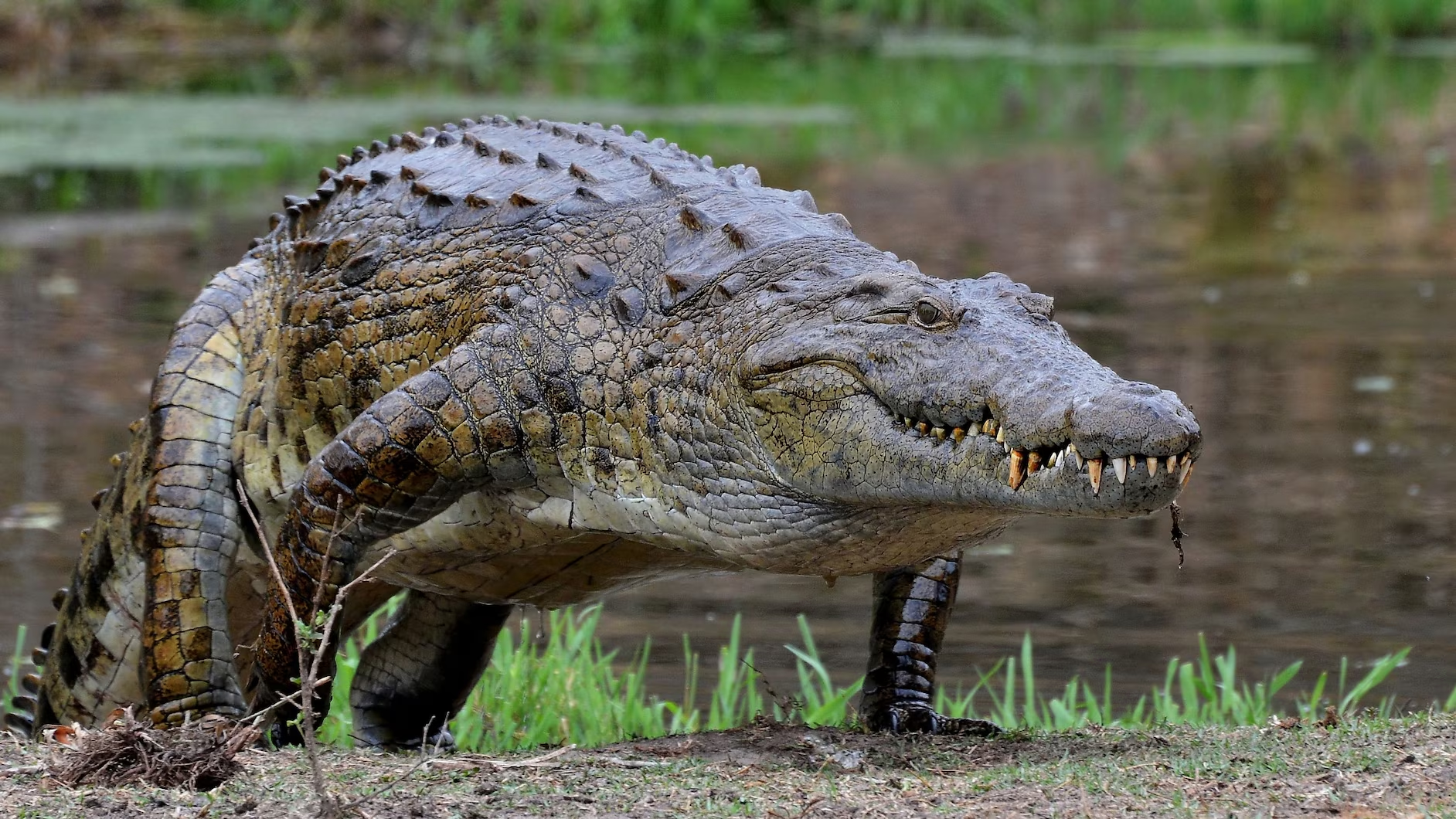
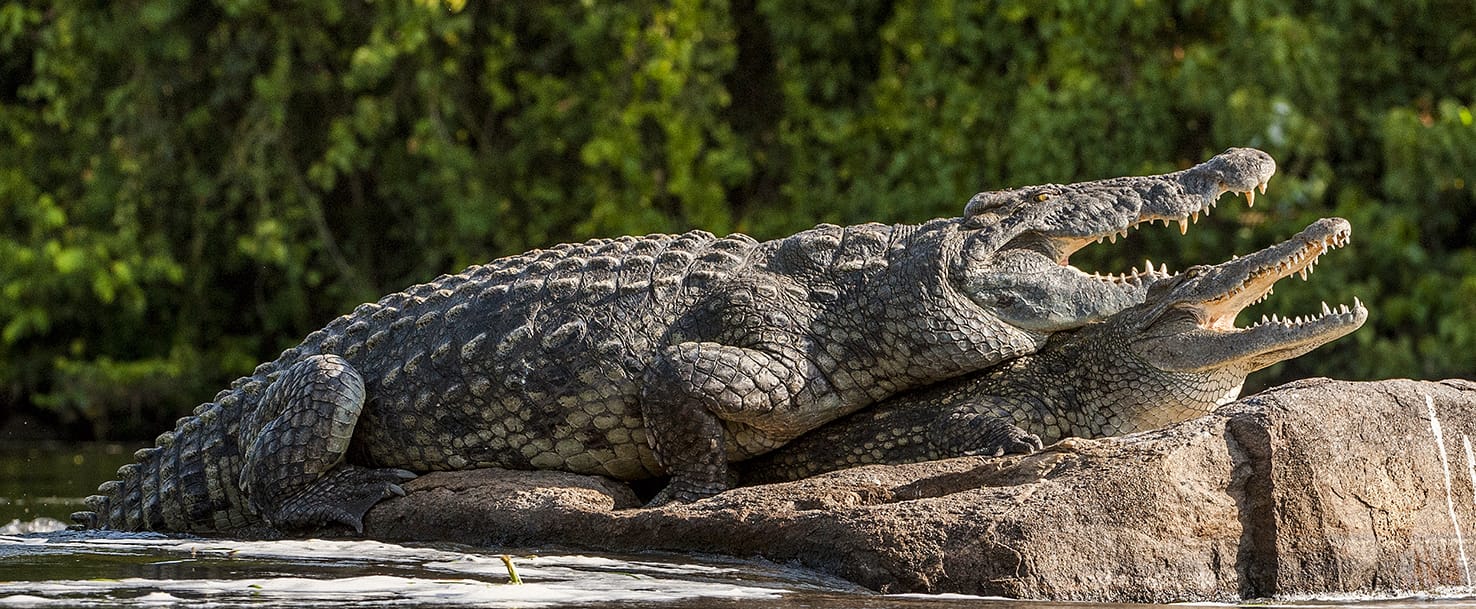
The Nile Crocodile Behaviour
If you stay with a Nile crocodile sighting for more than a quick photo, its behaviour starts to reveal a clear pattern of energy saving and opportunity. For long stretches, the crocodile lies perfectly still, mouth open slightly to help regulate body temperature, eyes half closed. It is not asleep in the way we think about sleep. It is waiting, conserving energy, letting the river bring chances to its jaws.
Socially, Nile crocodiles live a life that mixes tolerance and hierarchy. You often see several individuals together on a sandbank, lined up so each can get enough sun without causing too many fights. Larger, older crocodiles tend to hold the best spots; smaller ones shift position or slide into the water sooner. When food appears, such as a carcass in the water, there is no polite sharing. Heavy bodies surge forward, tails thrash, jaws snap, and each animal grabs what it can.
Communication happens through body language, touch and sound. A raised head, a particular jaw angle or a sudden lunge can send a clear message along the bank without a single audible word for you to hear. During the breeding season, males produce deep bellows at the surface, making water vibrate around them. They may inflate their bodies slightly and slap their snouts on the water. From the shore, you see ripples and hear heavy, low sounds that feel more like vibrations than simple noise.
Movement in water is where the Nile crocodile shows its most refined side. On the surface, it can look heavy and slow. Below the surface, with legs tucked in and tail swinging in smooth waves, it moves with a quiet grace that feels almost unfair for an animal that size. It can rise under a bird on a branch, wait near a narrow animal path to the water, or float downstream like a drifting log until the right moment arrives. The patience behind that kind of hunting is something you begin to respect, even if you feel uneasy.
The Nile Crocodile Diet
The Nile crocodile diet starts with fish and small aquatic animals when it is young, then expands as size and strength grow. A small crocodile catches frogs, crabs, insects and little fish in shallow water, learning how to snap and hold without losing the prize. Those skills scale slowly. With each year, the jaws grow stronger, the body heavier, and the menu larger.
Adult Nile crocodiles are opportunistic predators and scavengers. They take fish, birds, turtles and mammals that come near the water, from small antelope to, in some regions, larger prey like zebra or even buffalo calves. Their classic move at river edges is a quick lunge from shallow hiding, jaws closing around a leg, neck or head, followed by a wrenching twist that drags the victim under. To watch this from a boat feels intense, sometimes shocking, yet for the crocodile it is simply the most efficient way to eat.
Carrion matters too. Nile crocodiles will feed on carcasses that drift downstream or lie half submerged after a crossing or a flood. Several animals may work on the same body, biting and twisting to tear off pieces. When a piece is too big to swallow, they grip it and spin, using the weight of water and their own mass to break it into smaller strips. This “death roll” looks violent, and it is, but it is also a very practical way of turning something unwieldy into manageable chunks.
Because they rely on ambush more than long chases, crocodiles can go for long periods without food when necessary. Their metabolism allows long fasting spells, especially in cooler weather, and their success depends less on hunting every day and more on taking big chances when they appear. That slow, deep patience is one of the reasons Nile crocodiles have survived for so many thousands of years along Africa’s rivers.
The Nile Crocodile Reproduction
Reproduction in Nile crocodiles begins with a long breeding season that often relates to local water levels and temperature. During this time, males claim stretches of riverbank and nearby water, patrolling, displaying and sometimes fighting rivals. A big male with heavy scars can control an attractive section of river where females like to bask and feed.
Females build nests on sandy or soft banks above usual water levels. Using their back legs, they scrape a cavity, lay a clutch of eggs, then cover them with soil and vegetation. A single nest can hold dozens of eggs. From that moment, the female’s behaviour changes noticeably. She stays close, basking near the nest, listening for danger and chasing away intruders, including other crocodiles and curious animals that wander too near the hidden clutch.
Temperature inside the nest influences the sex of the hatchlings. Slight changes in warmth can tilt the balance between males and females. The eggs incubate for several months, their fate tied to weather, nest placement and luck. When the young are ready to hatch, they begin to call from inside the shells, making small, sharp sounds that the mother hears through soil and sand. She responds by carefully uncovering the nest with her jaws and feet.
In one of the most surprising scenes for many visitors, the mother carries the hatchlings to the water in her mouth. Tiny bodies disappear between heavy teeth, yet she does not bite down. Instead, she releases them at the water’s edge or into a shallow nursery area, sometimes staying close for days or weeks. Many dangers still exist; fish, birds, monitor lizards and other crocodiles all take young. Yet that brief period of intense care gives at least some of her brood a real chance to join the long, slow lives of adult Nile crocodiles.
Recommended Safaris

11 Days
Private
11 days Uganda Premium Gorilla, Wildlife & River Nile Adventure
from
$ 2900
per person
8 Days
Private
8 Days Murchison Falls, Gorilla, Chimpanzee & Queen Elizabeth Safari
from
$ 1790
per person
5 Days
Private
5-Day Kahuzi Biega Congo Gorilla Trekking & Chimp Safari in Rwanda
from
$ 2500
per personThe Nile Crocodile FAQs
Are Nile crocodiles dangerous to humans?
Yes, they can be dangerous near open riverbanks and lakeshores, especially where people fetch water or wash clothes. On guided boat trips and from vehicles, you stay at safe distances.
Where are the best places to see Nile crocodiles on safari?
You see them clearly along rivers in Murchison Falls, Queen Elizabeth, Serengeti, Maasai Mara, Kruger, Chobe, the Okavango and many other protected waterways that still hold strong populations.
How big can a Nile crocodile grow?
Large males can reach impressive lengths and heavy weights, especially in rich river systems where fish and mammal prey are abundant. Most you see are smaller, yet still powerful.
Do Nile crocodiles eat only meat?
They are carnivores, feeding mainly on fish, birds and mammals. Young crocodiles sometimes take insects and smaller prey before moving to larger targets as their bodies and jaws strengthen.
Are Nile crocodiles active at night?
They can hunt by day or night, yet many feeding events happen in low light when animals come to drink. During hot hours, they often bask or rest quietly in shallow water.
Do Nile crocodiles migrate or move long distances?
They move along rivers and between pools as water levels change, especially in seasonal systems. Floods, droughts and human activity can all push them into new stretches of water.
How long do Nile crocodiles live?
They can live for many decades in the wild when they avoid serious injury, disease and human conflict. Older individuals often carry scars that hint at long, hard lives.
What should I do if I am near crocodile water on foot?
Keep back from the water’s edge, avoid washing or standing where banks are low and muddy, and follow local guide advice. Crocodiles rely on surprise; distance removes that advantage.
Conclusion
Spending time with Nile crocodiles changes how you feel about African rivers and lakes. The water stops being only a calm surface for reflections and turns into a living space with quiet, patient eyes below. You begin to read muddy edges differently; notice drag marks on the bank and think carefully before calling any place “safe” without question.
For a traveler who arrives excited about big cats and elephants, the crocodile often becomes a slower, deeper memory. You remember a heavy body on a sandbank, mouth open, birds picking insects from its armour. You remember a silent slide into water, leaving only circles behind. You remember that steady stare from a few metres away, and the realization that this river has its own old guardian.
Browse other sightings
Griffin Falls
Moroto town
JINJA-the source of the Nile
The Great Rift Valley
Igongo Cultural centre
Hot springs and Geysers
Lake Edward
Mabira Forest
Pian Upe Game reserve
kororo falls
Karamoja Apalis
Ssese islands
Don’t wait,
book this adventure safari today
Low season
Oct, Nov, Mar, Apr, may
Peak season
Jun, July, Aug, Sept, Dec

Got any questions
about traveling to Uganda?
Get in touch.
