

Select Page
Ostrich: Facts, Reproduction, Classification, Habitat, Diet and More
The Ostrich Introduction
Your first serious look at an ostrich in Africa can feel slightly confusing. You know they are big, but when one walks past the vehicle, the height and the calm stare feel different from what you expected. The long neck sways, toes press into the dust, and for a moment you are very aware of how small you are beside a bird that simply keeps walking.
If you grew up with ducks or chickens as your idea of birds, the ostrich resets the scale in your head. Here is a bird that looks you in the eye from above, with legs built like a runner and eyes as wide as some small mammals. It lowers its head to inspect something on the ground, then stretches up again and suddenly the whole grass plain feels like a running track built around it.
What makes the ostrich special is the mix of comedy and power. The shape can make you smile, especially when a group of them jog together across the savanna. Then your guide mentions how fast they can run and how strong those legs really are, and the whole picture gains another layer. You notice the heavy toes, the muscle lines in the thighs, the fixed focus when a bird decides to move in a straight line.
Many travelers later remember their first ostrich more clearly than they expected. Perhaps a male in breeding colours standing black and bold against golden grass. Perhaps a female sitting low over a nest while the heat wavers above the sand. Or perhaps a pair trotting away in that steady, elastic stride, taking your attention with them long after the vehicle turns back to other animals.
Recommended Safaris

14 Days
Private
14-Day Uganda, Congo & Rwanda Gorilla Trekking & Wildlife Safari
from
$ 4900
per person
Where to See Ostriches
Ostriches live in open savanna, semi-arid plains and light bush across much of East and Southern Africa. You meet them where grass, low shrubs and wide horizons come together.
1.Kidepo Valley National Park, Uganda
If you want wild ostriches in Uganda, Kidepo is your place. The open savanna in the Karamoja region gives them space to run, with wide golden valleys framed by rugged hills. You often see small groups walking across short grass in the Narus or Kidepo valleys, their long necks rising above the plains while buffalo and antelope graze in the background. It feels remote, almost like the ostriches and a few scattered herds have the park to themselves.
2. Nairobi National Park
Nairobi National Park is one of the easiest places on the continent to see ostriches if someone is short on time. The park starts almost at the edge of the city, so you can be watching a pair of ostriches on open grass with high rise buildings faint in the distance. They share the plains with zebra, gazelle and rhino, and sometimes walk right across the red murram tracks in front of the vehicle. For a first timer, it feels slightly surreal to meet a wild ostrich before lunch and be back in a city hotel by afternoon.
3. Serengeti National Park, Tanzania
If you want classic “ostrich on the plains” scenes, Serengeti is hard to beat. The birds stride through open grass, weaving between Wildebeest, zebra and Thomson’s gazelles, especially on the short grass plains in the south and east. You often see pairs or small groups standing a little apart from the herds, their necks rising above the grass as natural lookout towers.
4. Ngorongoro Crater, Tanzania
Inside the crater, everything feels closer, including ostriches. They cross the flat floor in full view, black and white males and brown females moving between buffalo, zebra and scattered flocks of crowned cranes. Because the space is contained, first time visitors are often surprised at how near the birds come to the tracks, which makes it an easy place to describe ostrich behaviour in detail.
5. Tarangire National Park, Tanzania
Tarangire gives you ostriches in more rugged, dry country. In the long dry season, you see them walking the open floodplains of the Tarangire River, sharing space with elephants, buffalo and huge baobabs. They often move in small groups, kicking up dust as they cross from one grazing patch to another, with the river and distant hills as a simple backdrop your reader can picture quickly.
6. Maasai Mara, Kenya
On the Mara’s open grasslands, ostriches feel like part of the daily traffic. You find them on gentle ridges and big, open flats, sometimes right beside grazing topi or among scattered Wildebeest herds. In migration season, the contrast between a solid black male and the moving grey mass of Wildebeest makes strong visual material for your writing, especially when storm clouds build behind them.
7. Amboseli National Park, Kenya
Amboseli offers those postcard views where ostriches walk under a distant Kilimanjaro. The plains here are quite open, so you often see birds far away first, then watch them grow larger as your vehicle approaches. They feed around the drier fringes of the swamp systems while elephants and hippos stick to wetter ground, which helps you describe how different species carve out their own niches on the same stage.
8. Kgalagadi Transfrontier Park, South Africa and Botswana
Kgalagadi is perfect if you want ostriches in a semi desert mood. Birds patrol dune crests and dry riverbeds, often at first light when the sand is still cool. They share the red sand with gemsbok and springbok, and you get those long, clean sightlines where a line of ostriches can stretch across an entire valley. It feels sparse, which helps you sell the idea of endurance and adaptation in your copy.
9. Kruger National Park, South Africa
Kruger gives frequent, easy ostrich sightings along main roads, especially in more open, grassy sections on granite soils. You might see a pair walking parallel to the road, or a male standing guard while a group of chicks pecks at tiny items on the ground. There is a nice contrast here between “big famous park, big famous mammals” and this huge bird that treats the road verges as part of its normal route.
10. Etosha National Park, Namibia
In Etosha, ostriches feel tied to the white pan and its hard light. They walk across pale flats and gather at waterholes, their reflections visible in shallow water when conditions are right. On some days you see them standing in heat shimmer on the pan edge, almost like mirages. That stark setting helps you write more dramatic lines without exaggerating anything.
11. Kafue and other Zambian plains
In wide, open parts of Kafue and similar Zambian savannas, ostriches mix with puku, lechwe and other antelope on big floodplains and grass pans. They are not as concentrated here as in East Africa, but when you meet a small group striding through waist high grass with distant tree lines behind them, the feeling of space is huge. It is useful for content where you want to emphasise remoteness and quieter tourism corridors.
12. Sahel belt and North African pockets
Historically, ostriches ranged far across the Sahel and North Africa. Today, truly wild North African birds survive only in scattered pockets in countries such as Chad and Cameroon, with reintroduction projects underway in parts of the Sahara. For most travelers these are specialist destinations rather than first trips, yet they give context when you explain that the bird once walked from the Atlantic coast across to the Nile and beyond.
Wherever you go, your chances improve when you slow down in open country, scan for tall shapes above the grass and watch for dust trails where a small group has started to run.
The Ostrich Classifications
Class: Aves
Order: Struthioniformes
Family: Struthionidae
Genus: Struthio
Species: Struthio camelus
Ostrich Gallery
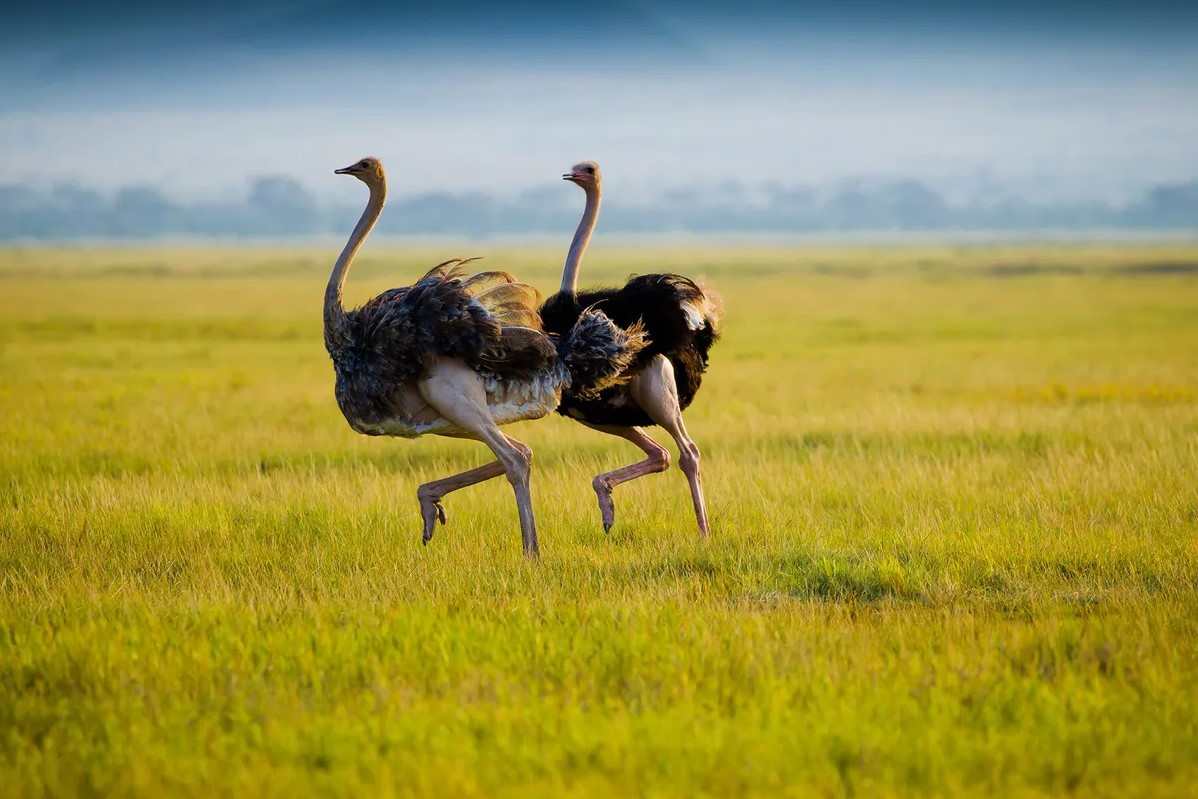
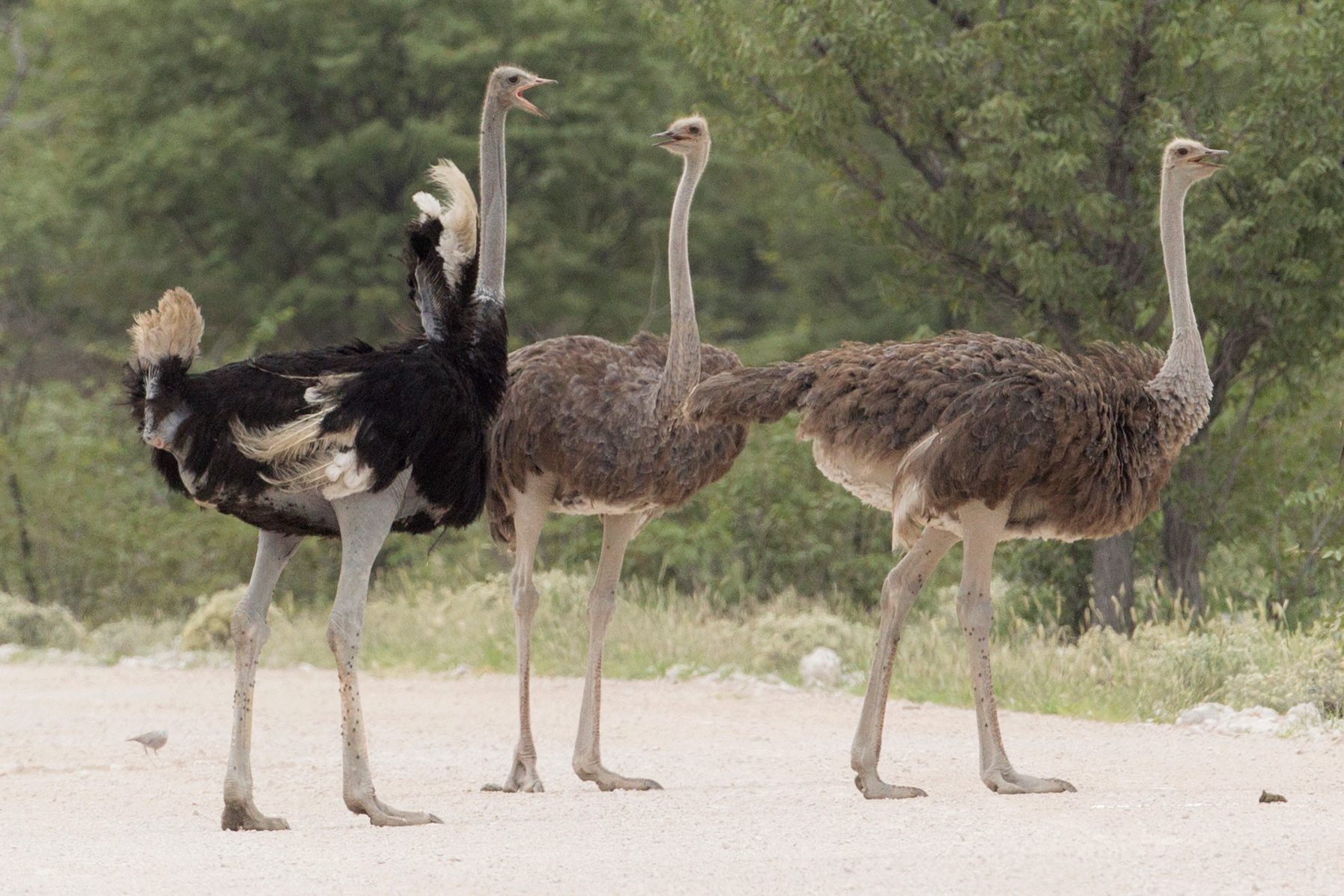
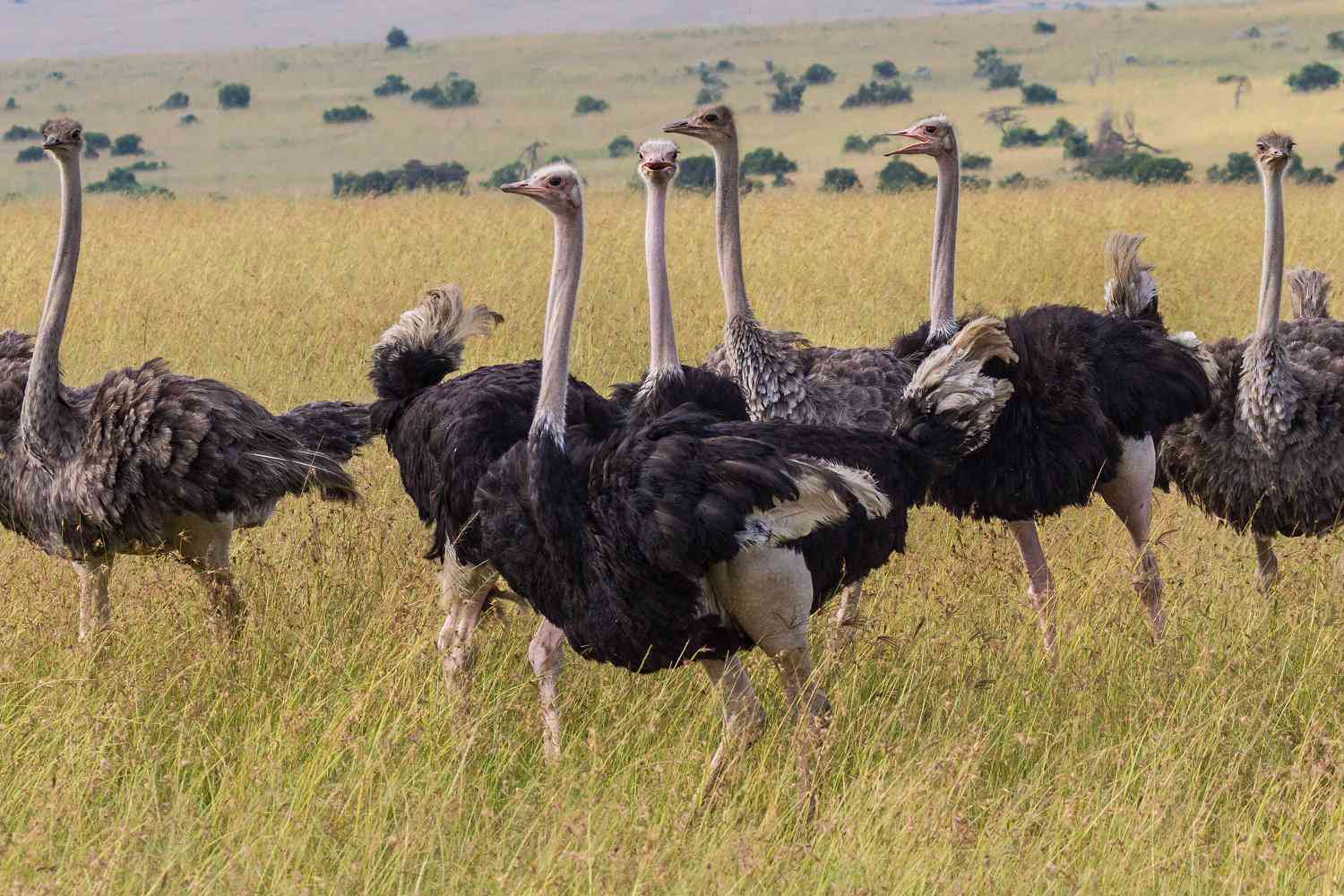
The Ostrich’s Behaviour
If you give yourself time with a group of ostriches, you notice how much their behaviour depends on space and sight. They like room to see trouble coming. Birds feed with heads down, picking at grass and small items on the ground, then every few seconds one lifts its head to scan in a slow, full circle. Others follow that lead, raising their necks almost in sequence, and for a brief moment the whole group stands tall before relaxing back into feeding again.
Ostriches live in loose groups that shift with season and local conditions. You may see a pair or a small family with chicks, or a mixed group of males and females sharing a good feeding area. Dominant males hold territories in breeding season and court females with elaborate displays. The dance looks both serious and slightly playful. Wings spread, feathers flare, the bird kneels and rocks, swinging the head from side to side in a controlled rhythm that feels almost like a slow performance for an invisible audience.
When threatened, ostriches rarely pretend to be gentle. Their first choice is usually distance. They run. That run is something you feel in your chest when you watch it for the first time. Long legs extend, feet grip and push, and the bird covers ground faster than many vehicles care to try on rough tracks. If escape on foot fails or a predator closes in too much, those same legs become weapons. A forward kick from an adult ostrich can harm serious predators, so most lions and hyenas prefer to aim at chicks or distracted birds rather than the full, focused adult.
Daily rhythm follows light and temperature. Early morning and late afternoon bring more movement and feeding, with birds covering ground in easy strides between patches of grass and low shrubs. During hot hours, they rest more, sometimes sitting with legs folded under them, necks relaxed, wings slightly open to release heat. Even then, eyes stay open and at least one bird acts as the main watcher, turning its head slowly as if it has all day to pay attention.
The Ostrich’s Diet
The ostrich has a broad, practical diet that fits open country. It eats grasses, seeds, leaves, flowers and a range of small animals, including insects, lizards and occasional small mammals when chances appear. You watch the beak move quickly as the bird walks, picking at anything that looks useful on or near the surface of the ground.
Because they cannot chew, ostriches swallow food in fairly large pieces. They rely on stones and grit in their gizzard to grind tough material. You sometimes see them pick up small pebbles with the same focused care they use for seeds. Those stones do real work later, inside the body, helping break down fiber and hard shells into something the bird can absorb.
They handle dry conditions better than many animals around them. Much of their water comes from the plants and fruits they eat. When open water is available, they drink, but they can go for stretches without visiting waterholes every day. That independence lets them use areas that would feel difficult for some other grazers and browsers.
The Ostrich’s Reproduction
Reproduction in ostriches brings some of the most interesting behaviour you can watch on dry plains. During breeding season, territorial males choose open spots within their range and perform repeated displays for females. The male lowers his head, spreads wings, and shakes his feathers in a controlled pattern, the neck weaving from side to side. The colours of the male, with black body and white feathers on wings and tail, turn each display into a strong visual signal across open ground.
Females lay eggs in a shared nest, usually a shallow scrape in the ground lined with a bit of plant material. One dominant female lays most of the eggs, and her position brings both risk and advantage. Subordinate females add a few eggs, which the dominant female often arranges so that her own sit in the safer center of the clutch. When you stand on a vehicle and look through binoculars, the nest can look like a pile of pale stones until you notice the adults nearby.
Both male and main female take turns incubating. In many areas the male sits at night, his darker body blending with shadows, while the female covers the eggs by day, her earth toned feathers fitting the light soil and grass. This shared routine lowers risk from predators that hunt by sight. When the eggs hatch, a group of fluffy chicks emerges, looking like small, striped versions of their parents. Adults lead them to feeding areas, watching for danger constantly.
Ostrich parents can be surprisingly protective. Chicks often gather in a crèche, with one or two adults watching several youngsters from different females. If threats appear, adults may distract predators by running toward them, spreading wings and acting larger and louder than usual, drawing attention away from the moving cluster of chicks heading in the other direction. Seeing that level of commitment in such a large bird can shift the way you think about parental care on the plains.
Recommended Safaris
8 Days
Private
8 Days Murchison Falls, Gorilla, Chimpanzee & Queen Elizabeth Safari
from
$ 1790
per person
The Ostrich FAQs
How dangerous is an ostrich to humans?
A cornered or provoked ostrich can be dangerous. Those legs can kick forward with serious force. On safari, you stay in the vehicle and give them plenty of space, which keeps encounters safe and respectful.
How fast can an ostrich run?
Ostriches can reach very high running speeds on short bursts, then hold strong pace across long distances. When you watch one run beside the vehicle, you quickly understand why most predators prefer surprise over a long chase.
Why can’t the ostrich fly if it is a bird?
Ostriches trade flight for running power. Their wings are small compared with the body, while legs and thighs carry heavy muscle. In open African plains, long distance speed often matters more than getting into trees.
Do male and female ostriches look different?
Yes. Males usually show black bodies with white wing and tail feathers, especially in breeding season. Females and younger birds tend to wear browner and greyer, which blends better with dry grass and soil.
What sound does an ostrich make?
Males can produce deep booming calls that you feel in your chest more than you clearly hear at first. They also hiss when alarmed. Chicks and females use softer calls to keep contact within the group.
When is the best time of day to see ostriches active?
Early morning and late afternoon give you the best movement, with feeding, walking and displays. In the hottest hours, they often rest or stand quietly, wings slightly open to manage heat.
Do ostriches live only on open plains?
They prefer open or lightly wooded areas where they can see predators coming, but they also use semi arid shrub country, dune ridges and open farmland edges where grass and low shrubs still dominate.
Can ostriches and other grazers share the same areas peacefully?
Yes. You often see ostriches near zebra, gazelle, wildebeest or cattle. They eat different mixes of plants and small animals, and their sharp eyes even help others by spotting danger early.
Conclusion
Spending time with ostriches changes how you think about birds. They stop being small shapes in trees and become full characters on the ground, with their own rules, speed and family drama. You begin to see open plains not only as spaces for antelope and predators, but also as a world where a huge bird reads tracks, wind and shadows in its own steady way.
For many travelers, one memory stands out. Perhaps a male in full display, wings shaking and neck weaving in bright evening light. Perhaps a line of chicks trotting behind two adults, tiny legs working hard to match the pace. Perhaps the quiet moment when an ostrich simply stood, watching you across a stretch of grass, both of you trying to decide what the other might do next.
Don’t wait,
book this adventure safari today
Low season
Oct, Nov, Mar, Apr, may
Peak season
Jun, July, Aug, Sept, Dec

Got any questions
about traveling to Uganda?
Get in touch.
