

Introduction
What really happens on the day you go looking for mountain gorillas in Uganda? Does it begin when you step into Bwindi Impenetrable Forest, or has the experience already started before you leave your lodge?
For a first-time visitor, gorilla trekking in Uganda can sound straightforward: wake up early, travel to the forest, walk through the vegetation, find a gorilla family and spend some time watching them. Yet the reality is much richer because the animals do not follow a visitor’s timetable, and the forest does not always make the journey predictable.
Your day can involve an early breakfast, a ranger briefing, steep forest trails, patient tracking, changing weather and several hours of uncertainty before the moment you finally discover the gorillas. Even then, the experience does not end when you see them. So, what might an ordinary day actually feel like?
Why does the day start so early?
The first surprise is that your gorilla experience begins before the trek itself. You will normally have an early breakfast at your lodge and prepare for the journey to the designated briefing point, giving you time to organize your water, camera, suitable clothing and sturdy footwear before entering the forest.
There is also a practical reason for starting early because gorilla families move through the forest according to their own routines, feeding, travelling, resting and interacting with one another.
By the time visitors arrive, the animals may already have moved considerably from where they spent the previous night. This means you are not travelling to a fixed viewing point. You are going to find them.
What happens before you enter the forest?
At the briefing point, guides and rangers explain what you need to know before beginning the trek, including how to behave around the gorillas, how to move through the forest and why visitors must follow the established rules.
This part of the morning is more important than it may initially appear because you are about to enter the natural home of an endangered species that shares many biological similarities with humans. Responsible behaviour therefore protects both the animals and the quality of the encounter.
You are also introduced to the realities of the trek. Depending on where the gorilla family is located, the walk can be relatively manageable or physically demanding, with Bwindi’s steep slopes, thick vegetation and sometimes muddy trails adding to the challenge. Then the group sets off, and the experience begins to unfold.

The day begins with a morning briefing before you enter Bwindi Forest in search of a gorilla family.
What is the forest like once you start walking?
This is where the experience becomes less predictable because there is no guarantee that you will spend the morning following a perfectly defined path.
Your guides and trackers may lead you through different sections of the forest depending on where the gorillas have moved, and you may walk for a while before stopping as the tracking team assesses the signs around them.
The trackers may move ahead while the rest of the group waits, after which everyone continues again. For a traveler, these pauses can feel like part of the mystery because you know that somewhere ahead a gorilla family is moving through the same forest, but you have no idea exactly where.
The trackers, however, are looking for clues, and their experience helps them interpret signs in the forest and establish the direction the animals have taken. This is why the trek is not simply a hike. It is a search.

Trekkers following narrow forest trails as they move deeper into Bwindi in search of the gorillas
How do you know when you are getting close?
There may not be a dramatic announcement when the gorillas are nearby. Instead, you may notice the behavior of the tracking team changing as they become more attentive, communication becomes quieter and the group begins moving with greater purpose.
Then perhaps you hear something, vegetation moves and you look through the leaves, only to discover that the animal you travelled across the world to see is suddenly there.
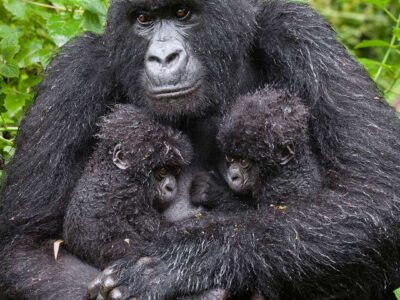
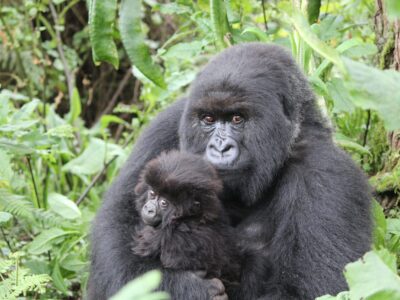
A silverback may be resting nearby, a mother may be caring for her infant or a young gorilla may be moving through the vegetation with remarkable curiosity.
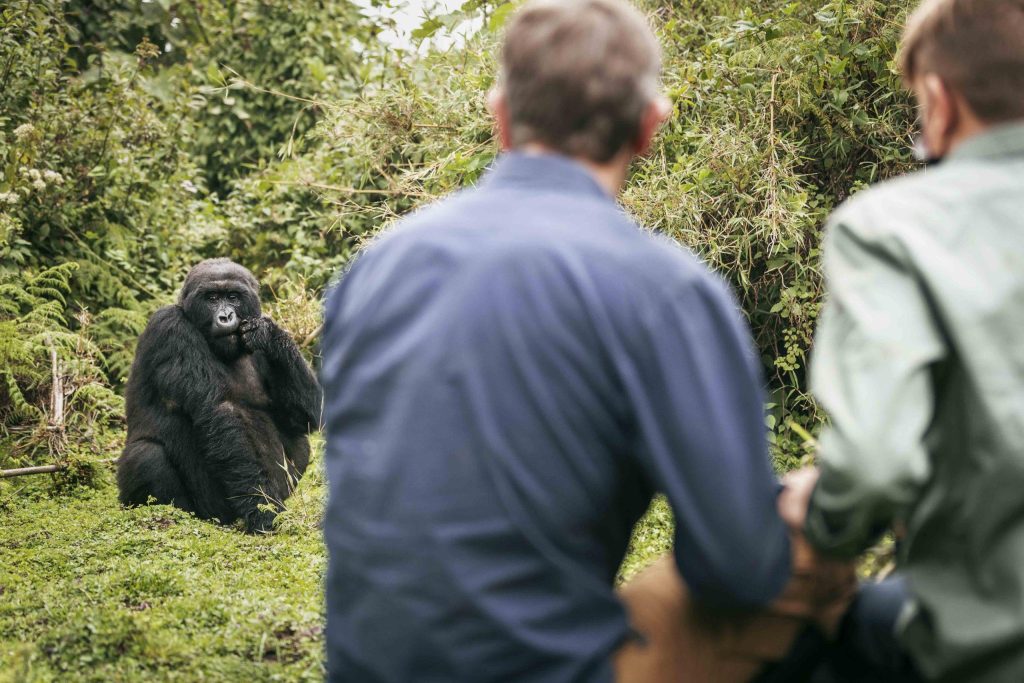
The interesting thing is that the gorilla may not appear particularly impressed by your arrival; it may continue feeding, rest, groom another member of the family or simply look in your direction before returning to whatever it was doing. That is what makes the encounter feel authentic. The gorillas are not performing for visitors; visitors are observing the gorillas.

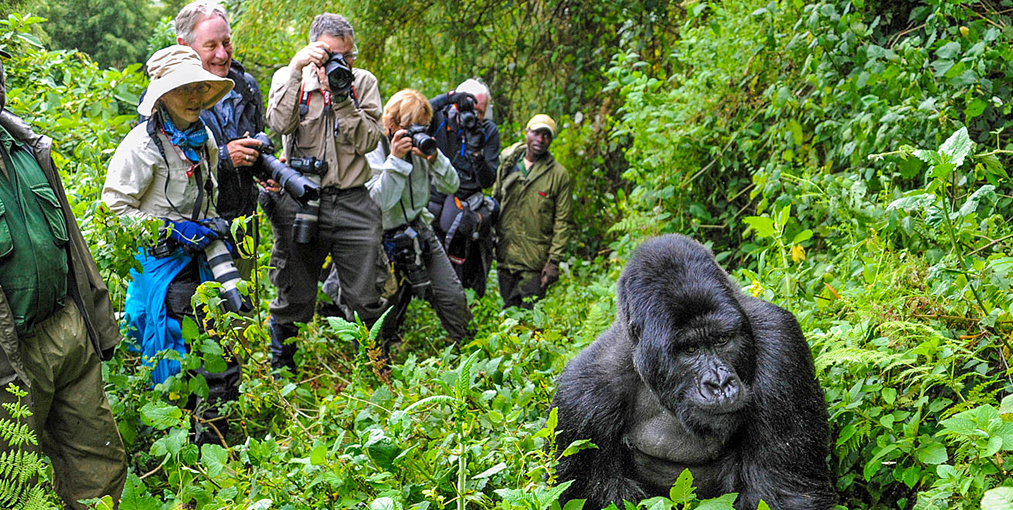
Trekkers encounter a mountain gorilla in its natural forest habitat.
Why can one hour feel so short?
Once the gorilla family is located, visitors have a limited period in which to observe them under the rules governing gorilla trekking. You might think an hour is plenty, but when you are standing in front of the family, the time can suddenly feel very different.
At first, you may focus on the silverback because of its enormous size and strength, but after a few minutes your attention can shift towards the smaller details: a young gorilla playing, an adult feeding quietly or members of the group interacting with one another.
You begin noticing behavior rather than simply looking at animals, and that is often when the encounter becomes most memorable. Your guide also helps you understand what you are seeing while ensuring that visitors maintain appropriate behavior around the family. Keeping the animals comfortable is more important than getting the perfect photograph.
What happens when the gorillas are left behind?
Eventually, the viewing period ends and the group begins moving away. This can be one of the strangest moments of the day because reaching the gorillas was the objective you had been thinking about since breakfast, yet now you are deliberately walking away from them.
But that is exactly how responsible wildlife tourism should work. The gorillas need to continue feeding, resting and interacting without prolonged human disturbance, while visitors leave the forest knowing they have been privileged to observe part of the animals’ natural lives.
The return journey can also feel different because you may be tired, your boots may be muddy and the steep sections may suddenly seem more noticeable than they did earlier.
Even so, there is usually a strong feeling that the effort was worthwhile because you have experienced something that cannot simply be recreated elsewhere.
What does the rest of the day look like?
Once you return to your lodge, the pace becomes much slower. You may have lunch, take a shower, rest and look through the photographs you captured, while this is also the time when travelers often begin discussing the moments they remember most.
Interestingly, it may not be the photograph of the biggest gorilla that stays with you. It could be the youngster that suddenly appeared from the vegetation, the quietness of the forest or the moment when you first realized the gorillas were only a few meters away.
Depending on your safari itinerary, you may spend the rest of the afternoon relaxing or taking part in another activity around Bwindi. The important thing is that you have time to slow down and appreciate what you have just experienced.


Ready for your ultimate wildlife experience?
Chat with us, our team is always here to help!


Got any questions
about traveling to Uganda?
Get in touch.
