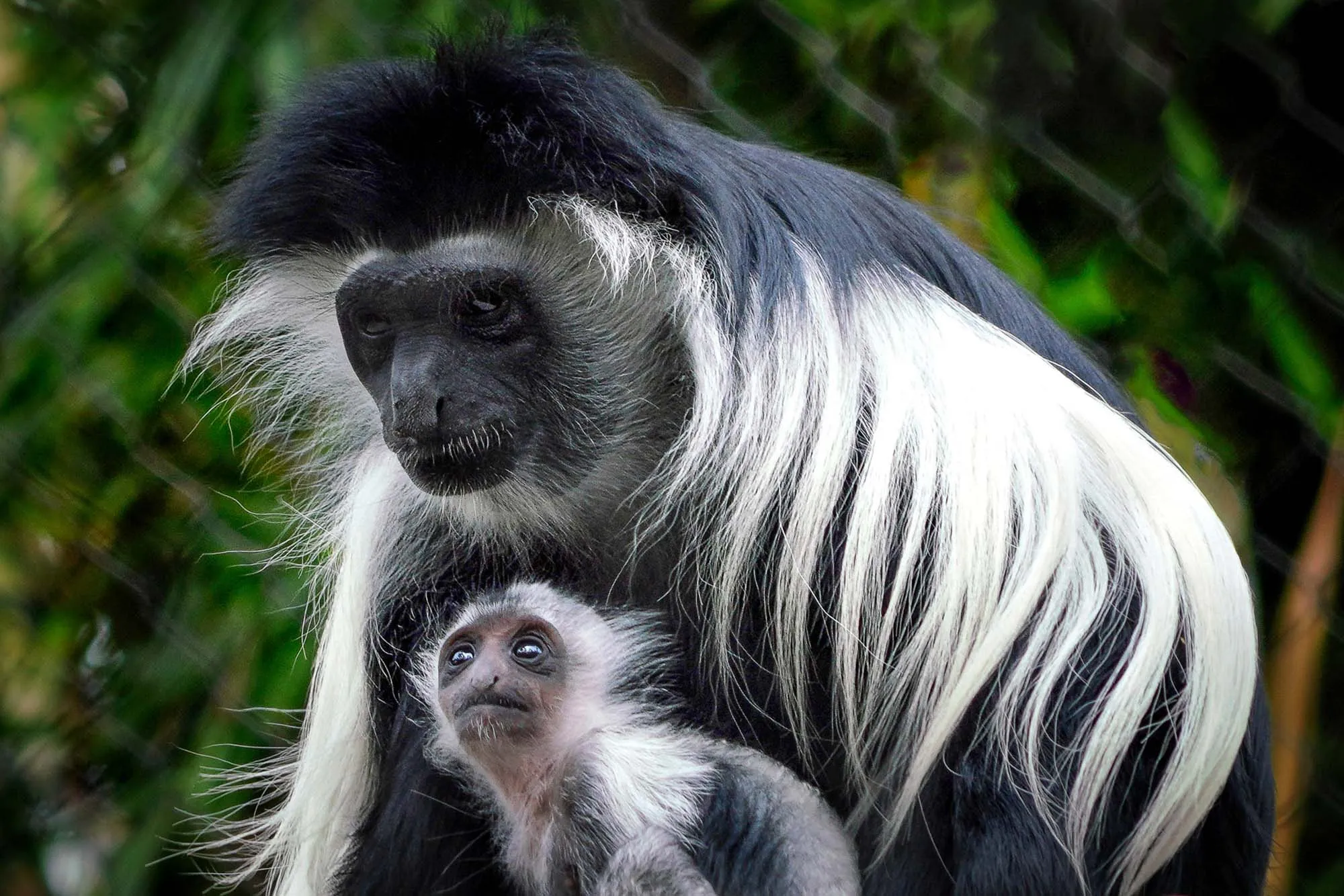
Black and white colobus monkeys are striking, tree- dwelling Old World primates native to Africa. Famous for their elegant white capes and lack of thumbs, they have complex, cow-like stomachs that allow them to digest tough and even toxic foliage that other animals cannot eat.
Physical characteristics
These monkeys feature a glossy black body contrasted by long, silky white frills. The eastern black and white colobus (colobus guereza) has a U-shaped patch of white hair across its shoulders, while the Angolan colobus (colobus angolensis) has white hair mostly flaring only from the shoulders.
The name colobus comes from the ancient Greek word kolobus, meaning “mutilated”. They lack functional thumbs, possessing only a tiny stump – which is a structural adaptation that enables them to swing and grasp branches seamlessly.
They possess a long, non- prehensile tail that can grow up to a meter in length, often ending in a bright white tuft. It acts as both a balancing tool and a parachute during daring leaps.
Their diet consists primarily of young, tender leaves, seeds, and unripe fruits.
They have cowlike stomachs because leaves are low in nutrients and tough to digest. They have evolved a complex, four-chambered stomach similar to a cow. This allows specialized bacteria in their gut to break down cellulose and neutralize plant toxins.
Social structure behavior
They live in small, cohesive family group of 3 to 15 individuals, typically consisting of one dominant male, several females, and their offspring.
Troops are highly territorial. At dawn, males make loud, resounding roars that can carry up to a mile through the forest to establish territory and signal neighboring groups.
Newborn colobus monkeys are born completely white with pink faces. Their striking coloring slowly shifts to adult black-and -white patterns by the time they are three to four months old.
Habitat
They inhabit a variety of forests across equatorial Africa, ranging from deep rainforests to montane woodlands and riverine environments. They spend their lives almost exclusively in the high forest canopy, utilizing their lack of thumbs to swing and leap seamlessly through towering branches.
Reproduction in black-and-white colobus monkeys
They practice polygyny, typically living in small troops with one dominant male and a harem of females. Females initiate mating, and after a gestation period of roughly 5 to 6 months, they give birth to a single infant that is born entirely white.
Predators of the black and white colobus monkeys
They face natural predation from leopards, chimpanzees, and crowned hawk-eagles, as well as significant threats from hunting.
Black and white colobus monkey Gallery
Other facts about the black and white colobus monkeys
They are highly arboreal primates equipped with specialized four-chambered stomachs. They are specialized leaf eaters because a leafy diet is low in nutrients and hard to break down; they possess a complex, multi-chambered stomach similar to a cow’s to ferment and extract nutrients.
They lack thumbs; therefore, they have only tiny, stumpy nubs where their thumbs should be, which actually helps them swing and hook effortlessly through tree branches.
They perform spectacular leaps using their massive bushy tails for balance; they can leap up to 30 to 50 feet between trees. Their long mantle hair and tail act somewhat like a parachute during these massive drops.
Babies are born completely white, while adults are black with striking white fur framing their faces and lining their backs; infants are born entirely pure white with pink faces. Their coats don’t change to the adult black and white pattern until they are about 3 to 4 months old.
Life span of black and white colobus monkeys
They typically have a life span of about 20 years in the wild, though they can live up to 30 years or more in human care.
Where to see white and Black colobus monkeys
They are highly arboreal primates found in a variety of closed forests, montane woodlands and riverine environments across equatorial Africa, ranging from Nigeria to Tanzania.
In the local viewing near you, you can easily spot them high in the treetops and forest canopies of protected Ugandan habitats like Queen Elizabeth National Park, and Murchision falls National Park, and Kibale National Park.
Conclusionsively, Black and white colobus monkeys depend heavily on mature, continuous forests, protecting their arboreal habitats is crucial for mitigating human wild life conflicts and ensuring these iconic primates thrive for generations.