
Sélectionner une page
Tanzania Great migration Safaris & Experiences
A Tanzania Great Migration safari is an unforgettable journey to witness over 1.5 million wildebeest, zebras, and gazelles loop 1,000 kilometers across the Serengeti National Park following the seasonal rains
The journey for the key players in the Great Migration, the roughly two million wildebeest, starts in the south of the Serengeti, with the birth of half a million calves between January and March.
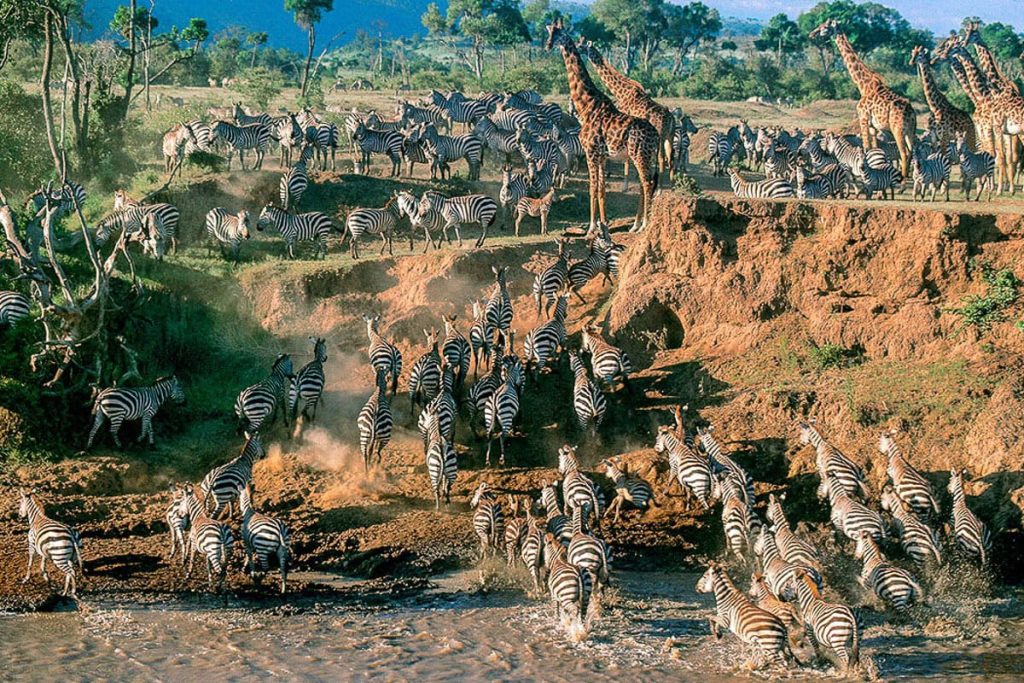
The Great Migration is the annual migration of massive herds of over two million wildebeest, zebras and gazelles across Northern Tanzania that includes the Serengeti and Kenya’s Masai Mara and could well be rated as the “Greatest natural show on earth.” Although most visitors seek out the iconic river crossings, the migration is on the move constantly, and resident game is plentiful wherever and whenever you choose to travel.
Voyages privés • Guides locaux • Itinéraires personnalisés • Extensions Safari
Durée typique
8 hours
Destination
Tanzanie
Idéal pour
Couples, célibataires, groupes
Meilleure saison
Juin-octobre, janvier-février
Style de voyage
Privé
Tanzanie Grande migration
Une façon plus riche de découvrir l’Afrique de l’Est
Tanzania Great migration in details
Pourquoi les gnous migrent-ils
The 800-kilometre trek of the immense wildebeest herd is the largest mammal migration on Earth. The timing of the migration coincides with the greening of nutritious grasses on the short-grass plains during the wet season. These areas are safer because prédateurs can be easily spotted, making it an ideal place for calving.
However, the plains dry and the wildebeest are forced to move in search of greener pastures in the western corridor. The northern extension of the ecosystem has the highest rainfall, but the grasses are least nutritious. This is the dry season retreat for the wildebeest, at least until the south becomes green again. The result is a clockwise movement from the south, west, north, and back to the south.
Tips for the Great Migration
Choose the best time to visit:
The best time to witness the Great Migration in the Serengeti National Park is from July to October. During this time, the vast herds of wildebeest and zebras are concentrated in the northern part of the park, making for spectacular viewing. However, Tanzania is a year-round safari destination, offering diverse wildlife experiences during different seasons.
Book your safari in advance:
Given the popularity of Tanzania safaris, particularly during the peak migration season, it is crucial to book your trip well in advance. Many luxury Tanzania safaris and camps have limited availability, so planning will help to secure your preferred accommodation and desired safari experience.
Pack essential items:
When embarking on a luxury Tanzania safari, it’s important to pack essential items to ensure your comfort and safety. These include lightweight, neutral-colored clothing, especially suitable for layering. Comfortable walking shoes, a hat, sunglasses, sunscreen, insect repellent, a camera with extra batteries and memory cards, binoculars, and any necessary medications.
Stay flexible:
While it’s essential to plan your safari, it’s also important to remain flexible. Wildlife sightings are unpredictable, and the best experiences often occur spontaneously. Embrace the unexpected encounters to make the most of the opportunities that arise during your safari adventure.
Respect wildlife and the environment:
As a responsible traveller, it’s crucial to respect the wildlife and the environment during your African safari in Tanzania. Follow the instructions of your experienced safari guide and maintain a safe distance from animals. Your actions contribute to the preservation of these incredible ecosystems for future generations.
Key destinations and timing
The Southern Serengeti with the Ndutu Plains is best from January to March for the calving season, when thousands of wildebeest calves are born daily. This therefore increases the population of the animals in the area.
The Western Corridor and the Grumeti River are best from May to July as herds gather and make the first dramatic river crossings. This is quite an interesting moment, seeing large herds of animals crossing at once
The Northern Serengeti and Mara River and is best from July to October for iconic and intense river crossings into Kenya.
The Central Serengeti, commonly known as Seronera, is good for general year-round game viewing and resident predators as herds pass through in April, May, and November.
The Eastern Serengeti and the areas of Namiri Plains are great from October to January for a quieter, migration-adjacent safari with high cheetah visibility.
COMPAREZ VOS OPTIONS
Best ways to experience Tanzania Great migration
Much as all our itineraries and safari packages can be customized to deliver unforgettable and more satisfaction, below are some of our top picks when it comes to Tanzania Great migration , feel free to customize and tailor to match your specific interests and needs.
14 jours
Privé
14 jours de safari en Tanzanie, au Kenya et en Ouganda (Serengeti, Masai Mara
depuis
$ 2000
par personne
10 jours
Privé
10 jours de randonnée dans les gorilles en Ouganda et safari dans le Masai Mara
depuis
$ 1700
par personneEXPÉRIENCE SIGNATURE
Tanzania Great migration in short.
This is one of the best experiences to have in Tanzania. This one is suitable for all ages and groups of people. Everyone is capable of being involved in this activity for example, the young ones can have an experience of this activity, the school-going children can also be part of this, the mature people can also have a test as well as the old.
This activity favors both the luxury travellers and the budget travellers irrespective of any circumstances. This is because animal viewing doesn’t involve extra payments
Durée typique
8 hours
Paramètre
Tanzanie
Style d'activité
PRIVÉ / GUIDÉ
Idéal pour
Solo, Couples, Groupe
À QUOI S'ATTENDRE
Comment se déroule l’expérience
Pourquoi les gnous migrent-ils
The 800-kilometre trek of the immense wildebeest herd is the largest mammal migration on Earth. The timing of the migration coincides with the greening of nutritious grasses on the short-grass plains during the wet season. These areas are safer because prédateurs can be easily spotted, making it an ideal place for calving.
However, the plains dry and the wildebeest are forced to move in search of greener pastures in the western corridor. The northern extension of the ecosystem has the highest rainfall, but the grasses are least nutritious. This is the dry season retreat for the wildebeest, at least until the south becomes green again. The result is a clockwise movement from the south, west, north, and back to the south.
Tips for the Great Migration
Choose the best time to visit:
The best time to witness the Great Migration in the Serengeti National Park is from July to October. During this time, the vast herds of wildebeest and zebras are concentrated in the northern part of the park, making for spectacular viewing. However, Tanzania is a year-round safari destination, offering diverse wildlife experiences during different seasons.
Book your safari in advance:
Given the popularity of Tanzania safaris, particularly during the peak migration season, it is crucial to book your trip well in advance. Many luxury Tanzania safaris and camps have limited availability, so planning will help to secure your preferred accommodation and desired safari experience.
Pack essential items:
When embarking on a luxury Tanzania safari, it’s important to pack essential items to ensure your comfort and safety. These include lightweight, neutral-colored clothing, especially suitable for layering. Comfortable walking shoes, a hat, sunglasses, sunscreen, insect repellent, a camera with extra batteries and memory cards, binoculars, and any necessary medications.
Stay flexible:
While it’s essential to plan your safari, it’s also important to remain flexible. Wildlife sightings are unpredictable, and the best experiences often occur spontaneously. Embrace the unexpected encounters to make the most of the opportunities that arise during your safari adventure.
Respect wildlife and the environment:
As a responsible traveller, it’s crucial to respect the wildlife and the environment during your African safari in Tanzania. Follow the instructions of your experienced safari guide and maintain a safe distance from animals. Your actions contribute to the preservation of these incredible ecosystems for future generations.
PLANIFIEZ EN TOUTE CONFIANCE
Tanzania Great migration planning Guide
Wildebeests migrate as a survival mechanism. Following the rains helps them find nutritious grasses and water sources. The journey is dangerous, with predators and river crossings threatening their lives
The migration happens year-round, but the best place to visit depends entirely on the month you plan your trip:
From January to March is the Calving Season, and they head to the Ndutu and Southern Serengeti plains. Thousands of calves are born daily, drawing intense predator action from lions, cheetahs, and hyenas.
From April to May is the transition where the herds begin moving north through the Central and Western Serengeti as the long rains start.
June to July is commonly termed the Grumeti River Crossings, where the herds gather in the Western Corridor and face their first major hurdle: crossing the Grumeti River. This crossing is quite difficult for several reasons, including predators and other challenges
August to October is termed the Mara River Peak, when they visit the Northern Serengeti, known as Kogatende, to watch the iconic, dramatic river crossings where herds brave crocodile-filled waters to cross into Kenya’s Masai Mara.
November to December is the return where the herds move back down through the eastern and central plains ahead of the short rains.
QUAND PARTIR
Best time for Tanzania Great migration
It is a matter of choice whether you would like to plan your Serengeti safari around the Great Migration. The chances that you will be at the exact spot of the Great Migration herd crossing a river, either at the Grumeti or Mara River, are very slim. Also, the timing of herd movements cannot be guaranteed.
However, if you choose the right part of the Serengeti, i.e., the southeast and Ndutu from December through to May, the Western Corridor from May to July, the Serengeti Mara area from July through to October, and the northern Serengeti and Lobo area in October and November, large herds of wildebeest and their entourage should be easily located.
BIEN PRÉPARER
Ce qu'il faut savoir avant de partir
Ensure you have a first aid kit; the chances are high that you never know what might happen to you while staring at an animal. A small cut, bruise or injury in the middle of the park can easily be infected, so it’s advisable to have bandages and cotton, which can be wrapped around any cut or injury.
Do not forget to pack sunscreen in case you are not comfortable with too much sunlight during the dry season. Likewise, a hat will also protect you from direct sun rays.
You definitely need a camera to photograph animals, so take extra batteries, lenses, and their waterproof cover. This will help you to capture your memories in case you need to reflect on them
Pack enough drinking water, energy drinks and food. Once you have set off from the park, you have no place to get eats and drinks. Usually your lodge prepares lunch boxes. Animals also move frequently in the forest, and it can take 30 minutes or more than 8 hours to locate them.
We recommend that tourists speak to their guides at the start of the drive about their stamina and fitness levels. Once you do that, you will be allocated to different positions that are easy to reach and avoid disappointment.
Hiking boots are essential over steep mountainous terrain between 2400 to 4500 meters above sea level in Volcanoes National Park and Mgahinga Gorilla Park. In Bwindi, the mountains have thick vegetation
VOYAGEZ AVEC DES SAFARIS AMICAUX GORILLES
Nous organisons plus que l'activité
Au cours des dix dernières années, nous avons organisé des voyages passionnants et inoubliables pour des centaines de milliers de clients.
Nous allons certainement rendre votre visite en Afrique de l’Est intéressante grâce à nos étapes simples et engageantes.
01
Conception de voyage
Nous adaptons l'activité, la destination, la durée du voyage et le safari plus large à vos priorités.
02
Permis
Nous réservons tous vos permis et entrées au bon moment pour que vous n'ayez jamais de surprises.
03
Transport privé
Toutes nos visites incluent des transferts depuis et vers l'aéroport gratuits. Aucun paiement supplémentaire à aucun moment pour la même chose.
04
Guides
Tous nos guides sont expérimentés, calmes et locaux. Ils rendront certainement votre séjour intéressant.
05
Hébergement
Nous utilisons uniquement les lodges que nous avons visités et tous les hébergements que nous utilisons sont parfaitement situés pour vous offrir plus de plaisir.
06
Extensions Safari
N'hésitez pas à ajouter d'autres activités et destinations à votre visite. Faites-le-nous savoir à l’avance pour une meilleure planification.
CONSTRUIRE UN VOYAGE COMPLET
Combine Tanzania Great migration with more of East Africa
COMBINER 01
COMBINER 01
Expérience d'habituation des gorilles
Obtenez une chance de raconter, observez les gorilles pendant 4 heures dans quelques parcs et uniquement à Rushaga.
FAQ ACTIVITÉ
Questions posées par les voyageurs avant de réserver
What is the Great Migration?
It is the largest mass movement of land mammals on Earth. The animals travel roughly 2,000 miles in a continuous loop between Tanzania and Kenya
Which animals take part?
The core herds include close to about 1.5 million wildebeest migrating all over, roughly 200,000 to 250,000 zebras, hundreds of thousands of gazelles and antelopes, and predators like lions, hyenas, leopards, and crocodiles that follow the herds
Is the migration always in Tanzania?
No. While the vast majority of the year is spent in Tanzania’s Serengeti National Park, the herds cross into Kenya’s Maasai Mara reserve typically from August to October
Are river crossings guaranteed on a specific day?
No. River crossings are completely unpredictable and depend heavily on local weather, rainfall, and herd instincts. You may wait hours or days to witness one.
COMMENCER À PLANIFIER
Build your Tanzania Great migration safari
Tell us your dates, number of travellers, preferred activity, comfort level and the other destinations you want to include. We will use those details to recommend a practical itinerary.
Vous n'avez pas besoin de connaître l'itinéraire exact avant de nous contacter.

J'ai des questions
à propos de voyager en Ouganda
Entrer en contact.
