
介绍
You have spent hours moving carefully through 布温迪’s thick vegetation, listening to the footsteps of your guide and the occasional crack of branches somewhere ahead.
Then the forest suddenly becomes quiet, and you notice movement between the leaves. A large mountain gorilla emerges and begins walking in your direction. For a moment, everything you have been told about gorilla trekking may seem to disappear from your mind. Should you move away?
Should you stand still? Could the gorilla attack? Or is it simply going somewhere? This is one of the most fascinating possibilities of a gorilla trekking experience, and understanding what to do can turn a moment of uncertainty into one of the most memorable encounters of your Uganda safari.
Why would a Gorilla walk towards you?
A 山地大猩猩 does not necessarily approach a visitor because it wants to attack. Gorillas are wild animals with their own routines, movements and social interactions, and sometimes their path simply brings them closer to the people observing them.
A gorilla may be moving toward another member of its family, searching for food, changing its resting position or simply passing through the area where you happen to be standing.
This is why your guide’s instructions matter so much. You are not entering the forest to control what the gorillas do; you are entering their environment and allowing the encounter to unfold naturally.
When a gorilla changes direction and starts coming toward you, the safest response is not to panic or make a sudden attempt to escape. Your guide and ranger know how to read the situation and will tell you how to respond.
Would you need to run away?
Probably the first thought that crosses your mind would be, “Should I run?” The answer is no.
Running, shouting or making sudden movements can create unnecessary tension during an already sensitive encounter. Instead, remain calm, listen carefully to your guide and follow the instructions given to you.
The experience can feel surprisingly intense because of the gorilla’s size. A silverback, in particular, can appear enormous when viewed from the forest floor, and watching one move through the vegetation toward your group can make the distance between you feel much smaller than it really is. Yet this is precisely when calm behavior becomes important.
Gorilla trekking guidelines require visitors to maintain a 7-metre distance from gorillas, and your ranger or guide will help manage the encounter if a gorilla moves closer.
The responsibility is not yours alone to judge every movement; trained personnel are there to interpret the situation and help visitors behave appropriately.

Rather than running when a gorilla moves nearby, trekkers remain calm and follow the guidance of their experienced ranger.
What if the gorilla keeps coming closer?
This is where the encounter can become especially interesting. You may be standing quietly when the gorilla continues moving in your direction, perhaps passing through the vegetation only a few meters away. Your instinct may tell you to step back immediately, but your guide will advise you on what to do.
The important thing is to remain composed and avoid sudden movements. Do not attempt to touch the animal, call it, follow it or deliberately move closer for a photograph.
The gorilla is allowed to move through its habitat naturally, and your group should give it the space required under the trekking guidelines.
Sometimes the animal may simply walk past you. It may barely acknowledge your presence before disappearing behind a curtain of leaves. Other times, it may pause, look in your direction and continue what it was doing.
Those few seconds can feel much longer because you are watching a wild animal at remarkably close range while knowing that you are a guest in its world.
Could a Gorilla attack you?
This is perhaps the question that makes the scenario so frightening for first-time trekkers. A gorilla’s strength is obvious, but that does not mean every approach is an aggressive encounter.
大猩猩 communicate through posture, movement, vocalizations and other behaviors, and experienced trackers and guides are trained to understand what is happening within the group.
A silverback may display powerful behavior when protecting his family or responding to a perceived threat, but visitors are given instructions precisely to reduce situations that could create unnecessary stress.
You should never deliberately provoke a gorilla, stare aggressively at it, attempt to chase it away or interfere with its movement.
The best response is to listen to the people accompanying you. They understand the environment, know the gorilla family being visited and can guide the group when circumstances change.

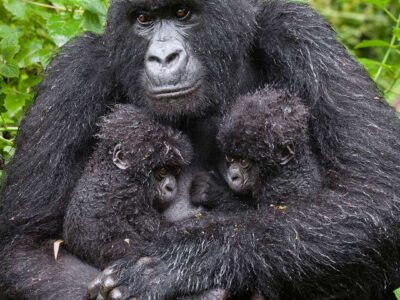
A powerful silverback stands watch over his family, showing why understanding gorilla behavior and following the ranger’s instructions is essential

What should you do if you are Face-to-Face with one?
Imagine the gorilla stops and looks in your direction. You are no longer simply watching it through binoculars or from a distant viewpoint. You can see its face, its movements and perhaps even the subtle expressions around its eyes.
This is where discipline matters more than excitement. Stay calm, remain with your group and follow your guide’s instructions. Do not reach out your hand, attempt to touch the gorilla or make exaggerated movements to get its attention.
Keep your camera ready only if you can use it without disturbing the animal, and remember that photographs are secondary to the experience itself.
You should also avoid screaming or laughing loudly out of nervousness. The goal is to allow the gorilla to continue behaving naturally while your group remains quiet and respectful.
What if it comes within the 7-Metre distance?
This is an important distinction. The 7-metre rule is a guideline for visitors to maintain distance from gorillas, but a gorilla can sometimes move toward the people observing it. That does not mean visitors should panic if the animal unexpectedly reduces the distance.
Instead, the ranger or guide will help manage the situation. This is one of the reasons visitors should never separate from their group or wander ahead independently. A trained guide can assess what is happening and determine the appropriate response.
In other words, you should never deliberately close the gap simply because a gorilla has approached you. Allow the animal to make its own movements while you maintain respectful behavior and follow professional guidance.

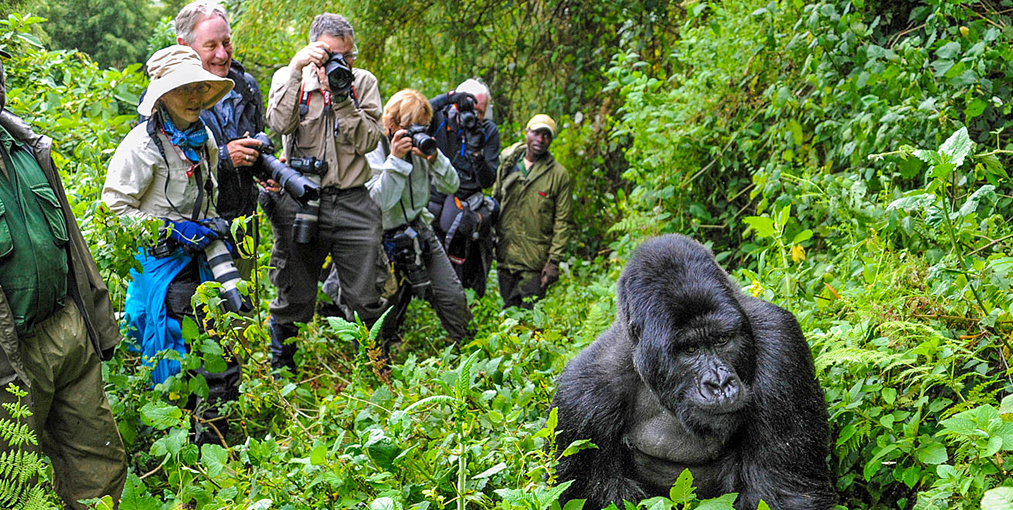
When a gorilla moves closer on its own, visitors remain where their guide directs them rather than deliberately closing the distance
Why can this moment become the highlight of your trek?
Interestingly, the most memorable part of gorilla trekking is not always the moment when you first find the family. Sometimes it is what happens afterward.
You may have spent the morning imagining what the encounter would look like, only to discover that the reality is completely different.
A gorilla might sit quietly beneath a tree, a youngster could move between members of the family, or a 银背 could slowly cross the area where your group is standing. Every encounter has its own character because the animals are not performing for visitors.
That unpredictability is what makes the experience so special. You cannot script where a gorilla will walk, what it will do or how long it will remain in one place. You can only prepare yourself, respect the rules and allow the forest to provide the moment.


准备好迎接您的终极野生动物体验
与我们聊天,我们的团队随时为您提供帮助!

有任何疑问
关于去乌干达旅行
联系我们。
